By Lisa Rowell



When you first hear the term, “hippotherapy,” it’s easy to do a double take and ask, “Hippo WHAT?”
As the subheading implies, hippotherapy has nothing to do with hippopotamuses—or is it hippopotami?
The term actually comes from the Greek word “hippos,” meaning horse.
Hippotherapy is a therapeutic approach that uses the movement of a horse in physical, occupational, or speech-language therapy to help individuals with neurodegenerative disorders like multiple sclerosis or cerebral palsy. By engaging core muscles, balance, and coordination, it significantly improves gross motor function.
Meet Dr. Coldiron
Michael Coldiron, OTD, OTR/L, CAS, is an occupational therapist at Total Pediatric Therapy in Somerset, where children receive occupational (OT), speech (SLP), and physical therapy (PT) services. A Somerset native, he specializes in pediatric therapy and holds certifications in Autism and Feeding Programs.
Dr. Coldiron emphasizes that hippotherapy isn’t a separate program but an integrated technique within standard therapy sessions to enhance patient outcomes.
A team effort
“Some days we’ve had four horses and all-day patients scheduled,” Dr. Coldiron says of the hippotherapy sessions. “Everybody involved has a career so we squeeze in as much as we can.”
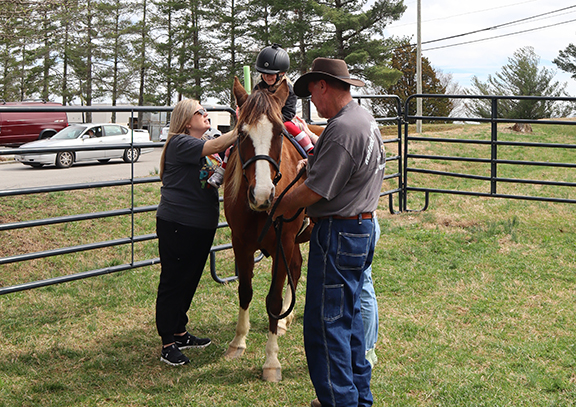
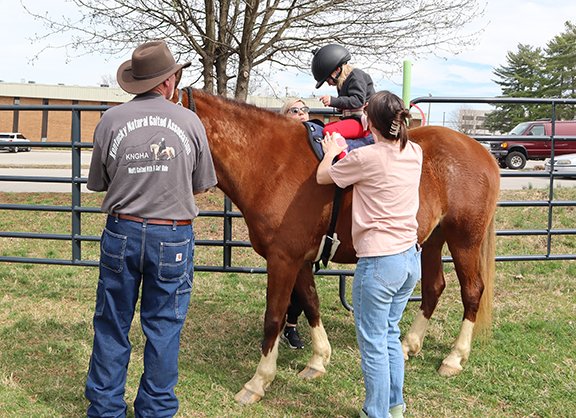
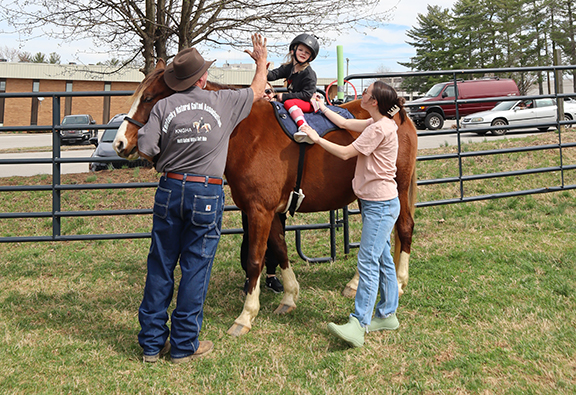
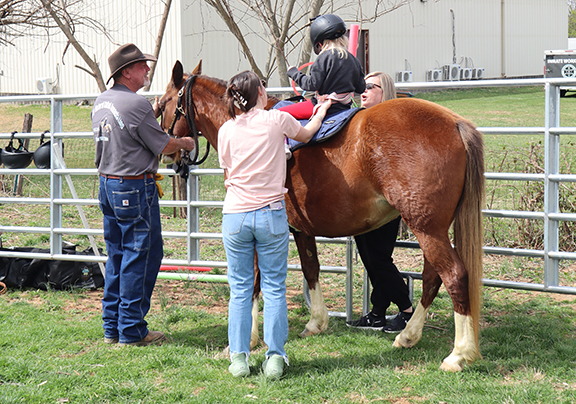
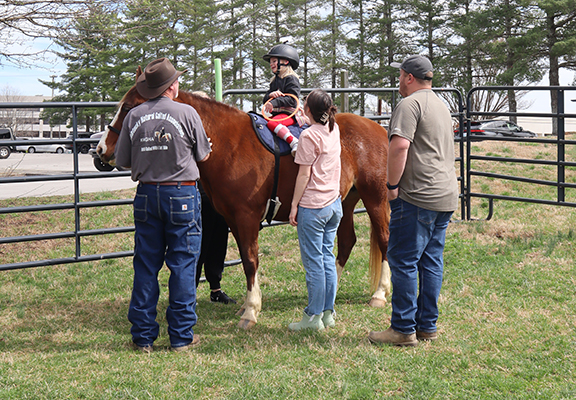
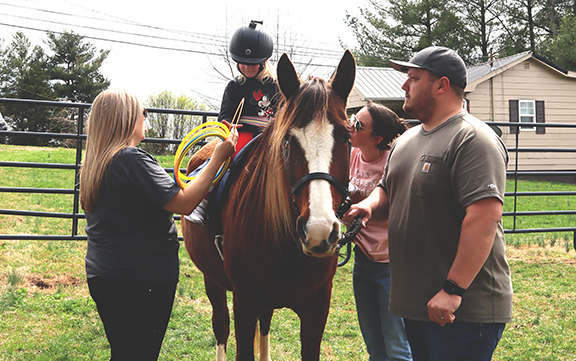
Dr. Coldiron says it takes a whole lot of team effort to have a session. Each session has one or two therapists — for instance a physical and occupational therapist, a technician or “sidewalker” who walks beside the horse on the opposite side of the therapist, and the handler in the front who is leading the horse.
Depending on a patient’s needs, the therapist, who is in charge of the visit, will ask the handler to guide the horse to do specific movements. Dr. Coldiron said the hippotherapy session will replace an in-office visit and could last about 30 minutes, depending on the tolerance level of the child.
Jerome Gullett, who owns horses Bay-be and LuLu, plus two others used in the program, says the most sessions he recalls in one day were 24.
“We have a waiting list for our clinic patients who want to do hippotherapy,” Dr. Coldiron said. “We don’t currently have the means to get them all in so we’re rotating.”
“I’m always careful when we’re talking about hippotherapy,” Dr. Coldiron said. “In all the trainings we’ve done to prep us for doing this — meshing health care with equine skill — we’re careful to say that it’s not about learning to ride a horse.” Dr. Coldiron explains that the children don’t have goals to learn to control or tack a horse. “That’s not what we’re doing. Those are riding lessons.”
He explains: “We’re using the horse’s movement to do specific things to the body or the brain of a patient.” The team’s patients who have taken part in the hippotherapy sessions have included those with autism spectrum disorder, pediatric stroke patients, cerebral palsy, and other conditions.
“There are certain diagnoses that are contraindicated,” Dr. Coldiron said. He explained that those conditions would make it unsafe for patients to have hippotherapy. “It’s not only a bad decision, it’s against the law and against our licensing board.”
Certification
Before offering hippotherapy, Dr. Coldiron and his team underwent rigorous training and certification. The American Hippotherapy Certification Board (AHCB) endorses voluntary certification to ensure the safe and effective application of hippotherapy.
From its website, The American Hippotherapy Certification Board (AHCB) states they endorse the concept of voluntary, periodic certification by examination for all professionals who use hippotherapy in their practice and that certification promotes delivery of safe and effective treatment.”
Dr. Coldiron and Jerome both said it took many months from the time they decided to use Jerome’s horses for this purpose, until it became a reality.
Not only did the staff and volunteers need to be trained but the horses needed to go through extensive training as well.

Jerome’s horses
Jerome Gullett, of the Kentucky Natural Gaited Horse Association (KNGHA), provides specially trained horses for hippotherapy. His horses exhibit a smooth, even four-beat gait, creating stable, rhythmic movements—crucial for riders with physical or developmental challenges.
Jerome, who is Dr. Coldiron’s neighbor, says working with the horses provides stress relief for him too. He has a full time job in addition to the work he does with hippotherapy.
The horses are put through “desensitization” training to ensure they are capable of handling the many distractions they will be exposed to during a therapy session.
LuLu (the white horse) is eight years old and she is expecting a foal soon. Jerome said it was her first time being at a hippotherapy session.
Bay-Be (or Baby Baby) is 11. Interestingly, she has one blue eye and one brown eye. Jerome said she was the first horse they used in hippotherapy. She’s also a favorite of Ellie Cromer, a young patient who eagerly anticipates each session.
Reining in expectations
Dr. Coldiron said many elements have to come together just right for hippotherapy sessions to take place. Keep in mind the staff also operates a clinic in the building behind the outdoor sessions so there are logistics all around to be worked out.

“We’re trying to expand our group of handlers,” he said, adding they’ve been fortunate to have such a high quality of people involved in the program. “There’s a process involved to make sure they’re comfortable around children and the horses. Can they handle the horse safely? So the more handlers we get the more flexibility we have. The long term goal — we want to do this a LOT.”
Prospective volunteer handlers should be 18 or older and have experience with horses. They also need to go through extensive training. The teams always have to be prepared for the unexpected and have the patient’s safety and best interests in mind.
Dr. Coldiron said that this time of year, when the weather cooperates, they might only get in a few hours each week with the horses.
For now, it’s only his clinic’s active patients who are participating in the hippotherapy which is billed through his office just like every other therapy session they offer. He said every session is noted in the medical chart and every movement or speech is notated. Each guided movement of the horse is designed for a specific purpose for each patient. “There’s really structured and specific communication,” Dr. Coldiron said.
Ellie and Bay-Be
As with all patients in hippotherapy, when Ellie Cromer arrived for her session, all safety precautions were adhered to before she ever went near the horse. Ellie is one of four daughters of Charles and April Cromer of Somerset.
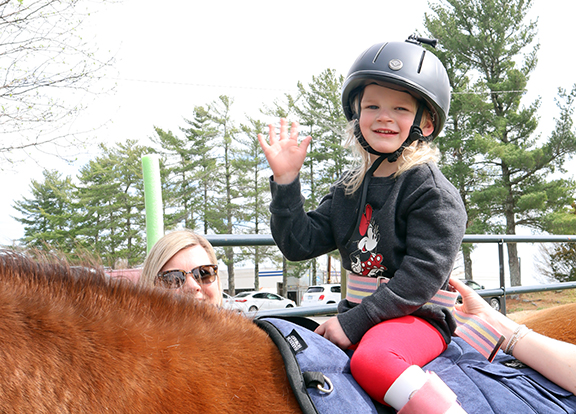
With helmet and gait belt in place, Ellie took to Bay-be like an old friend. And Bay-be welcomed her. Charles said Ellie has been participating in hippotherapy sessions for three months. “Every single day she asks to ride her horse Bay-be,” Charles said. It’s easy to see how this little girl and “her horse” have bonded. “She’s been on some of the other horses but that’s her favorite one,” he said.
With physical therapist Dr. Lori Meece, and EKU occupational therapy grad student Emily Hall at Bay-be’s sides, Jerome took Dr. Meece’s instruction in guiding the horse around the pen. For Ellie, it seemed like fun and games while she placed rings on pool noodles throughout the pen and eagerly listened to Dr. Meece’s instructions for her.
Dr. Coldiron explained that Ellie has cerebral palsy and was receiving both physical and occupational therapy that day. “Everything we’re doing here, the position of the horse’s withers [part of the spinal column that projects upwards between the shoulder blades] in relation to her hips, is promoting a stretch,” he explained. “We’re asking her to shift her weight and lean a certain way.” He said the motions they are asking Ellie to do all have specific purposes and are not random.
Charles said he has learned a lot from watching Ellie’s sessions. “You can definitely tell a difference,” he said.
For more information, visit: totalpediatrictherapy.com/; americanhippotherapyassociation.org/
 Compass Communications