Story by Lisa Rowell
In 2007, I lost my firstborn son. He was 18 years old. March 21 of this year marked the day he’s been gone for as long as he was alive. When he got his driver’s license, Jake chose to become an organ donor. Because of that choice, many people were given a chance at a healthier and better life after his untimely death. As the mother of a donor child, it was an extreme honor for me to hear Levi Goff’s story and to share it in this space. This story not only celebrates the journey of Levi and his family for the beautiful gift he was given, but it also helps me honor the gifts my son gave through his final act of generosity. If you are not already registered as a donor, please consider doing so. -Lisa
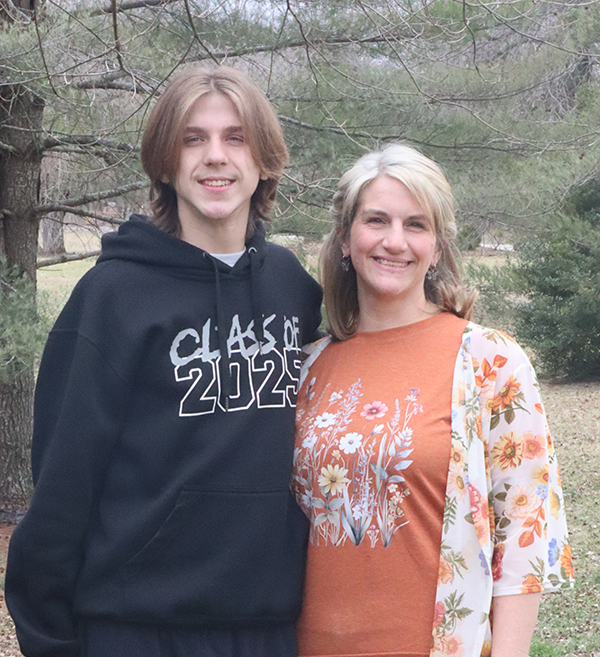
Levi and Laurie Goff on the 17th anniversary of Levi’s life saving surgery. (Photo by Lisa Rowell. ) 
https://www.donatelifeky.org/ 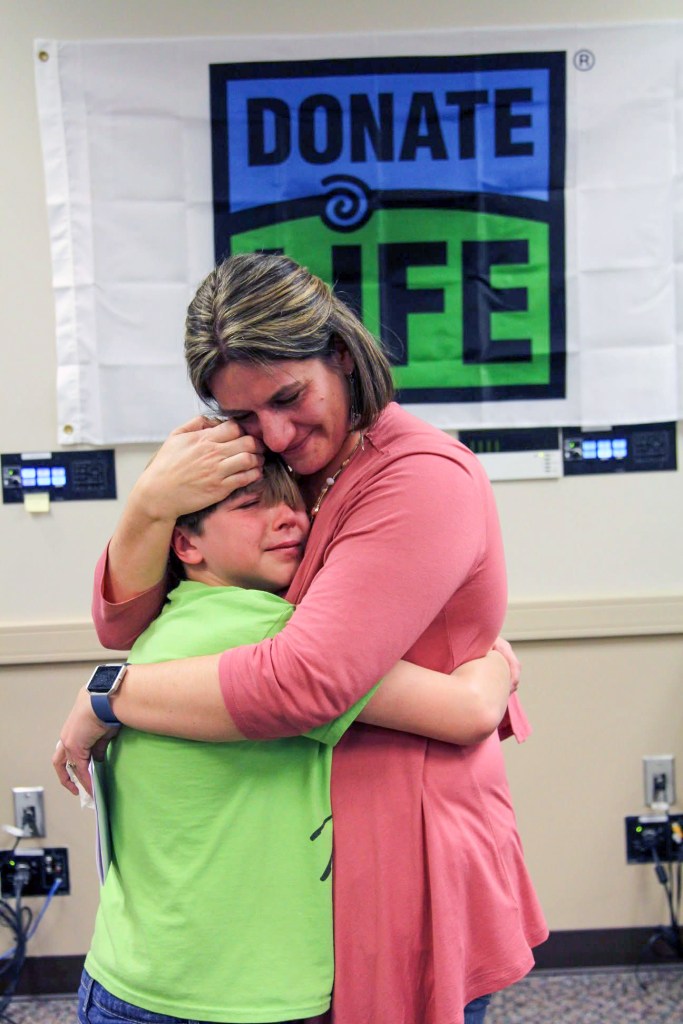
Levi and Laurie Goff celebrated Levi’s ten-year anniversary of his transplant on March 7, 2018. Laurie recalled the day: “We flew his donor mom, Tasha, and her sister and both their kids from Maine to celebrate with us. We invited friends and family. The hospital allowed us to use one of their conference rooms and provided food. This picture was taken after I spoke to everyone and told our story and of course broke down crying. He’s heard me tell the story so many times, but this was the first time I’d seen it bring him to tears. He doesn’t remember those scary moments and I am thankful he has only known the story and doesn’t have the memories of being so sick.” Submitted photo by Kelly Burton. 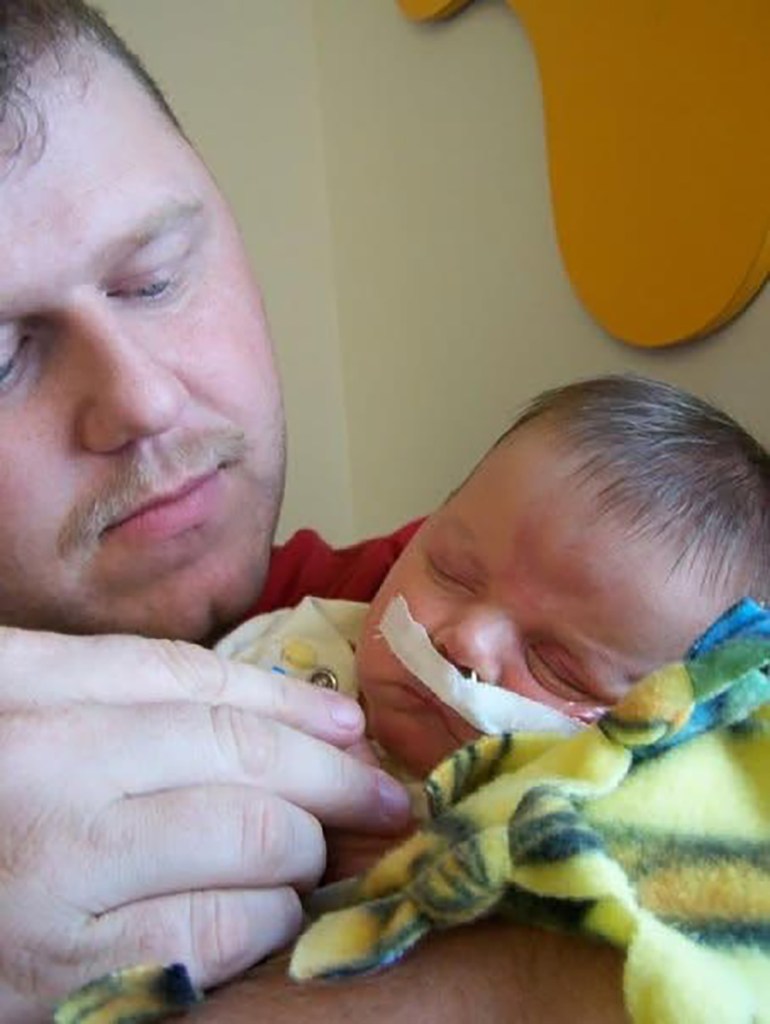
Levi as a baby with his father, Robin. Submitted photo. 
The Goff family at Coney Island outside of Cincinnati in July, 2022. Cincinnati Children’s Hospital Liver/Intestinal transplant team hosts a picnic every summer for recipients and kids on the waiting list and their families. Laurie said, “We’ve been almost every year.” Left to right, Laurie, Wiley, Robin, Toby, Levi, Brandon, and Jacob. Submitted photo. 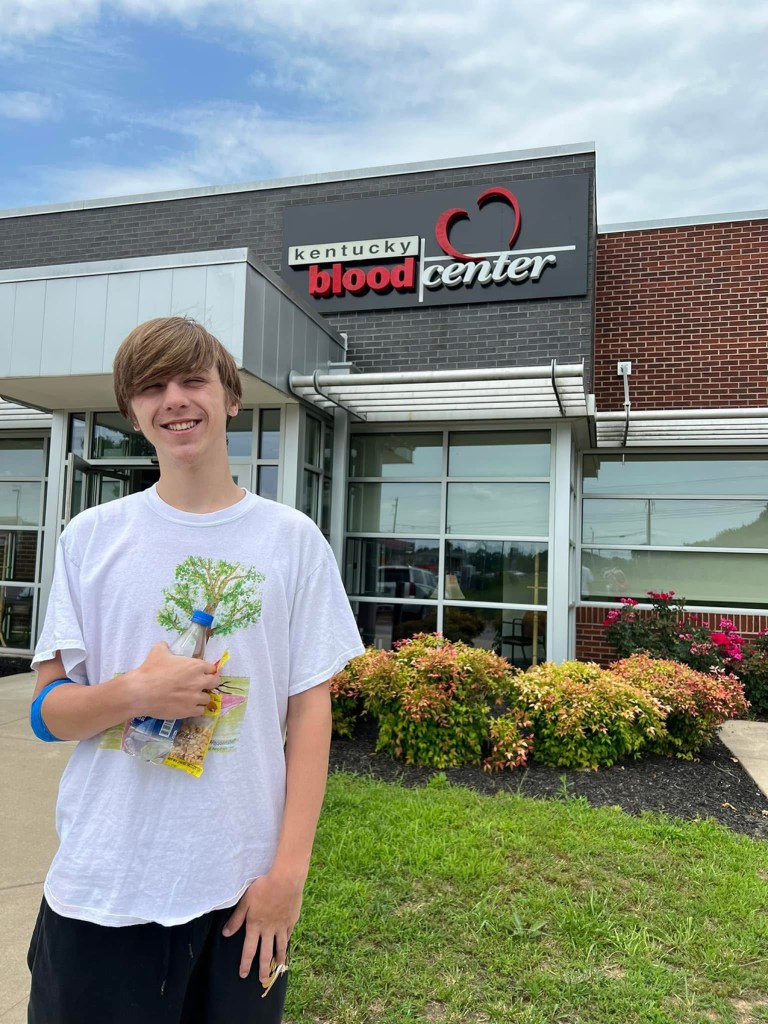
Levi Goff chose to become a blood donor as soon as he was eligible in order to help others. Submitted photo.
There are more than 104,000 people in the United States on the national donor transplant waiting list. Shelley Snyder, Executive Director of Donate Life Kentucky said, “That’s moms, dads, brothers, sisters, babies,” all waiting for a donor.
Shelley, whose office is located in Louisville, said 15 people die every day waiting for their gift of life. “I am happy to report that number has gone down over the years. We’re seeing an incredible increase in donation and transplantation.”
This staggering number includes people waiting for organs like kidneys, lungs, and pancreases.
Shelley, who joined Donate Life Kentucky as the executive director in 2010, had previously worked as a family support liaison for an organ procurement agency. The organization works with every county in the state. She knows what these families are enduring as they are losing a loved one. She said they are either honoring that loved one’s decision to be a donor or are having to make that choice on their behalf.
“Families are going through the worst day of their lives,” she explained, “but they are having the generosity and humanity to think of others.”
Donor awareness
In the work Shelley does in our Kentucky communities, she wants to convey the importance of being a donor. “We need everyone to register to simply say, ‘If I could, I would save a life.’ ” She emphasized that if everyone was registered as a donor, the waiting list would not be so long.
“When we’re out in the community, we just want to let them know what this mission means, to register as an organ donor, which is different than actually ever becoming an organ donor,” Shelley said.
“More and more people are saying yes to donation but still we want to continue to get that word out to save every life that could possibly be saved,” she said.
Shelley said registering brings hope to many, yet it’s quite a rare gift as it is not always medically possible to become a donor. There are many complex factors at work to make it happen, including a dedicated group of individuals from the organ procurement organization (OPO). In Kentucky, the Cincinnati area, and portions of West Virginia and southern Indiana, that organization is Network for Hope.
“It’s done with care and compassion,” Shelley said of the process.
Different teams may come from different areas. For Levi Goff, his gift of life came all the way from Maine.
Levi’s Story
Laurie Goff says anytime someone has a question about organ donation she tries to tell their family’s story. “This is what good can come out of such a tragic situation,” she said.
The family’s journey would be filled with as many bumpy roads as there would be blessings.
Levi, who is now a healthy 17-year-old senior at Pulaski County High School, is the fourth of five boys born to Robin and Laurie Goff. Laurie is a registered nurse at LCRH and Robin is an APRN with Cumberland Bariatric Institute.
Levi was just eight months old when he received his multiple organ transplant.
“He was born a little early but there were no complications,” Laurie recalled. “We went home after the usual hospital stay.”
When Levi was almost two weeks old, things would change. Laurie said Levi was pale and his color was off. She and Robin knew something was not right so they took him to the emergency room.
Once stabilized, Levi was transfered to the Cincinnati Children’s Hospital where doctors found a blockage in Levi’s bowel. Laurie said the tiny infant was taken to surgery where it would be discovered that Levi had been born with intestinal malrotation where his bowel was not attached to his belly. He developed complications when the intestines became twisted (which is called a volvulus), resulting in a blockage of blood flow to the bowel.
Laurie said when the surgeon explained the severity of Levi’s condition, the family was told that it is not be possible to live without a bowel. Their baby’s surgical wound was intentionally left open and he was sent to the ICU where he would be observed overnight. The hope was that his intestines would regain their pink color.
“We prayed all night and cried all night,” Laurie said.
The news that followed in the morning was grim. Laurie said they were given the choice to let their baby pass away while sedated or try a small bowel transplant. Levi was only two weeks old and weighed six pounds. Laurie said the doctors told her he needed to be a year old and weigh at least 20 pounds to be considered for the surgery which would require a donor.
“In our minds, that was the only option. If there’s a hope, a chance… I could not not give him a chance,” Laurie said.
Levi was taken back into surgery where all but three centimeters of his small intestine would be removed. Only ten percent of his large intestine would remain. He received a permanent IV and a feeding tube to sustain him until he was healthy enough to have the transplant. Laurie said she was told there was risk of infection that went along with having the IV.
Levi has no recollection of anything he endured as a baby.
“He was such a happy baby, always,” Laurie said. “Even with tubes coming out of him.”
The wait begins
“Luckily, Cincinnati has a transplant center that does small bowel transplants,” Laurie said.
While the Goffs waited for Levi to be healthy enough to receive a transplant, there would be complications including life threatening infections, and more hospitalizations.
“We wouldn’t stay home for more than a week or two,” Laurie said. She had a to-go bag packed and ready at all times. “As soon as you felt him feeling warm, you’re like, ‘Oh, here we go again.’ ”
Laurie said they learned to guard that IV line with their lives. “I was constantly afraid he was going to pull it out,” she said. They also had three running toddlers in their home at the time.
Levi underwent constant evaluations, testing, labs, and blood transfusions. Laurie said the long term effects of the feeding tube also damaged Levi’s liver which heightened the risk for him to develop varices (enlarged veins in the esophagus).
Levi would be put on the organ donation waiting list for a small bowel and a liver.
Laurie said they were thankful to be home during Christmastime.
The call comes

That winter, Levi was admitted to the hospital in Cincinnati to evaluate what turned out to be an ulcer.
“While we were there, they decided to give him a unit or two of blood,” Laurie recalled.
Laurie said they stayed at the hospital overnight and there was a huge snowstorm that rolled through the region.
“While we were there getting blood, we were told they found organs,” Laurie said.
Had they been home, Laurie said the snowstorm may have kept them from being able to get to Cincinnati.
“We were right where we needed to be,” she said. “It also helped that he was already admitted. It was a blessing that we were there at that moment.”
That moment would feel bittersweet. While Laurie’s child had a chance for life, she realized another child had just lost theirs.
“It’s very hard to describe,” Laurie said about how she felt. “You feel guilty for being happy.”
Mixed feelings
Shelley Snyder tried to put it into perspective. “It’s not about wanting the demise of someone else,” she said. “It’s complex for those recipients. It’s not an easy journey to need a transplant.”
She said they try to offer words of comfort to the recipients. “The donor families want you to live, that’s why they gave you this gift.” It’s natural to feel guilt or regret but the donor families want the best for you.
Coming full circle, as a donor mom, I agree with what Shelly said. I did not think twice about my son’s decision to be a donor. Jake was generous to a fault. In the midst of the shock and emotional turmoil of losing him, there was also a deep understanding that nothing would alter the outcome. Nothing would bring him back.
It was a comfort to know that my son’s last act of generosity would ultimately help sixteen people live better lives.
I would not have thought about his choice to be a donor in any other way, nor would I have wanted those recipients to feel anything less than blessed that someone who agreed to be a donor ultimately matched their needs.
Levi’s Life saving surgery
“The wheels started turning and we started getting him prepped for surgery,” Laurie said of Levi, who by this time was eight months old.
“It was a very long surgery,” Laurie said. Levi had an entire team of medical professionals overseeing every step. Laurie said she could not say enough kind things about the care Levi received in Cincinnati.
Ultimately, Levi would receive a liver, an intestine, and a pancreas from a five-week-old donor. He would lose his spleen.
Levi is on an immunosuppressive drug, Prograf, to prevent organ rejection. He also takes an antibiotic to prevent infections since he doesn’t have a spleen. He also takes a medication to help with his digestion.
Just a normal kid

“By the time he’s in kindergarten,” Laurie says of Levi, “he’s a normal kid.” She said she was worried about him going to school because of the anti rejection medication. “He has a plan at school. They’re supposed to let us know if there’s people that are sick in his class. He’s allowed to carry water with him to make sure he doesn’t get dehydrated.”
“We have to follow up once a year to make sure everything is working good,” she said.
“He does everything his brothers have done,” Laurie said. Levi will be graduating from high school this year. He was a life guard at SomerSplash Water Park last summer. As soon as Levi was old enough, he became a blood donor for the Kentucky Blood Center so he could help others.
Laurie said she feels this journey with Levi has led her to becoming a better nurse and enhanced her empathy for what patients are going through.
Meeting Levi’s donor family
“Levi’s donor’s mom is from Maine and we brought her down for his tenth transplant anniversary,” Laurie said. They were not aware Levi’s donation had come from Maine nor did they connect to the donor family until serendipity would reveal that years after the surgery.
Laurie said about two years after the surgery, she decided to write to the donor family, following the facility’s strict protocol. The donor family had the option to receive the letter or not. “I never heard anything back so I just assumed that they didn’t want to respond,” Laurie said.
When Levi was six or seven, the Goffs took a family trip. The initial plan was to travel out west. With gas prices being so high, Laurie said they scrapped the idea and chose to visit the Northeast instead. During their trip, they were on their way to Maine from Niagara Falls. They had no set itinerary and just booked rooms as they needed them. Heading to the motel for the night, Laurie said she received a message. A former co-worker shared a Facebook post from a woman who was looking for her daughter’s organ recipient.
Laurie said the woman’s post stated she had received a letter from her daughter’s recipient family but had lost it. She was trying to find a way to connect with them. The details of the post were too uncanny for it to be anyone other than the mother of Levi’s donor.
At this point, Laurie had no clue Levi’s donor had come from Maine. She was able to connect with the woman and it would turn out that she lived 30 minutes from the very motel the Goffs were staying at that very night!
Three pillars
Shelley said Donate Life Kentucky focuses on three pillars — public education, fund raising, and donor family celebrations.
Shelley said almost 70 percent of Kentuckians are registered. In Pulaski County, that number is 63.4 percent.
“Anyone can be a donor, regardless of age, medical history, or background. We encourage everyone to take a moment to register, have conversations with their families, and help spread awareness. One donor can save up to eight lives and enhance the lives of more than 75 people.” She also said healthy individuals can be living donors for a kidney or a portion of their liver.
Shelley said organ donation also provides healing and comfort to donor families. “Knowing their loved one’s legacy lives on can bring immense peace during difficult times.”
Donate Life Kentucky has a fund to help support families with travel expenses including gas, hotels, medication, and other expenses to help meet the needs of donor families.
The non-profit organization has several fund raising activities throughout the year including events at Churchill Downs before the Derby, awareness walks, summer and fall raffles, and third party events. If your organization is interested in helping with a fund raiser or you would like to make a monetary donation, visit donatelifeky.org/financial-contributions/
You may contact Shelley via email: ssnyder@donatelifeky.org, or call her office: 866-945-5433.
Through the organization’s patient and family support services, they want to help patients get back to life – protecting it and celebrating it.
Donate Life Kentucky

Headquartered in Louisville, and founded in 1992 by the circuit court clerks of Kentucky, Donate Life Kentucky is part of a nationwide effort to educate and encourage organ, eye, and tissue donation. They work closely with the Kentucky Transportation Cabinet Driver’s License offices and other community organizations. The goal is to increase public education about the lifesaving mission of donation and to grow the Kentucky Donor Registry.
The organization’s full-time staff of seven is dedicated to providing public education and supporting donor families and transplant patients in financial need.
In 2024, nearly 300 organ donors in Kentucky helped save more than 600 lives. Thousands of tissue and cornea donors enhanced the quality of life for burn victims, cancer survivors, and those with vision loss.
Registering as an organ donor is simple. Sign up at the Driver’s License office when renewing your license or register online at RegisterMe.org. There’s no age limit and no health questions.
Kentucky residents can sign up through the Kentucky Donor Registry at donatelifeky.org where you can also read the many beautiful gift of life stories.
Discuss your decision with your family so they understand and can support your
wishes.

 Compass Communications