With Dr. Ausef Ahmed

Parkinson’s Disease is estimated to affect about one million Americans, and more than 10 million people worldwide. According to the Parkinson’s Foundation, these numbers are expected to rise by 2030. Parkinson’s is the second most common neurodegenerative disease after Alzheimer’s disease.
Nearly 90,000 people in the U.S. are diagnosed with Parkinson’s Disease (PD) each year.
Dr. Ausef Ahmed, neurologist with Lake Cumberland Neurology Associates in Somerset, says patients with PD will often describe the disease as feeling as though they are locked in their bodies. He said they may have the mental capacity to move, yet their bodies are restricting them.
Although there is no cure for Parkinson’s, Dr. Ahmed offers hope for trying to live one’s best life while staving off the effects of the disease for as long as possible.
Stay active
“One 50-minute, moderate intensity, aerobic exercise per week is the recommendation for most Parkinson’s or other neurodegenerative patients,”
Dr. Ahmed offers, stating studies show that patients who follow an aerobic exercise protocol can have delayed onset of symptoms. “They stay more functional for a longer period of time,” he explained.
“Whatever makes you short of breath and makes your heart go a little faster is helping you in one way or another.” Dr. Ahmed suggests that in order to get the full benefit of an aerobic exercise, be sure to get that recommended 50 minutes. He said being active is not enough. “If your heart rate is not going up, it’s not an aerobic exercise.”
“I also like to add a little bit of weight training for my older patients,” he says, suggesting at least 15 minute durations using small weights of three to five pounds.
“Do some exercises for your core and for your arms and legs to improve your muscle tone and bone density,” Dr. Ahmed adds. He stresses the importance of having enough strength to help prevent fractures from falls. “Once they get a fracture, that basically puts them down for a very long time.”
Dietary suggestions
Dr. Ahmed recommends dietary changes that may help delay Parkinson’s symptoms. The “MIND” diet (Mediterranean-DASH Intervention for Neurodegenerative Delay) combines elements of the Mediterranean and DASH (Dietary Approaches to Stop Hypertension) diets. The purpose is to promote brain health and reduce the risk of cognitive decline and Alzheimer’s disease.
Key components include emphasizing vegetables, fruits, berries, whole grains, nuts, seeds, and beans; using olive oil as the primary cooking oil; consuming fish at least once a week and poultry at least twice a week. The diet also suggests reducing intake of red and processed meats, butter and cheese, and sugary drinks.
Dr. Ahmed recommends PD patients make sure they are not vitamin deficient and are getting get adequate Vitamin D. (If you are uncertain, ask your primary care practitioner to test your levels.)
Role of the microbiome
Dr. Ahmed says research suggests that our gut microbiome — that immense collection of microorganisms that live in and on the human body — might also play a role in PD.
“There is a GI predisposition that as your gut chemicals and flora change over time, it can predispose patients [to PD],” Dr. Ahmed says.
The National Library of Medicine says a PD study confirmed the gut microbiota contributes to motor deficits and neuroinflamation. As Dr. Ahmed indicates, the study suggested that changes to our gut microbiome may represent a risk factor for PD, potentially contributing to disease onset, progression, or even symptoms.
Dr. Ahmed says this theory might be a factor for being predisposed to other neurodegenerative diseases as well.
Familial Parkinson’s
There is genetic testing available for PD, however, Dr. Ahmed says it only applies to a more infrequent form of PD that runs in families. “Those Parkinson’s patients are usually younger patients,” he says.
A report by Johns Hopkins Medicine indicates that the genetic link to PD occurs in about 15 percent of patients and is caused by genetic mutations which increase the risk of developing the disease.
Dr. Ahmed says a PD diagnosis is more rare for younger individuals. “The usual age is age 60 and above. If it happens earlier than that we call it early onset Parkinson’s Disease.”
Diagnosis
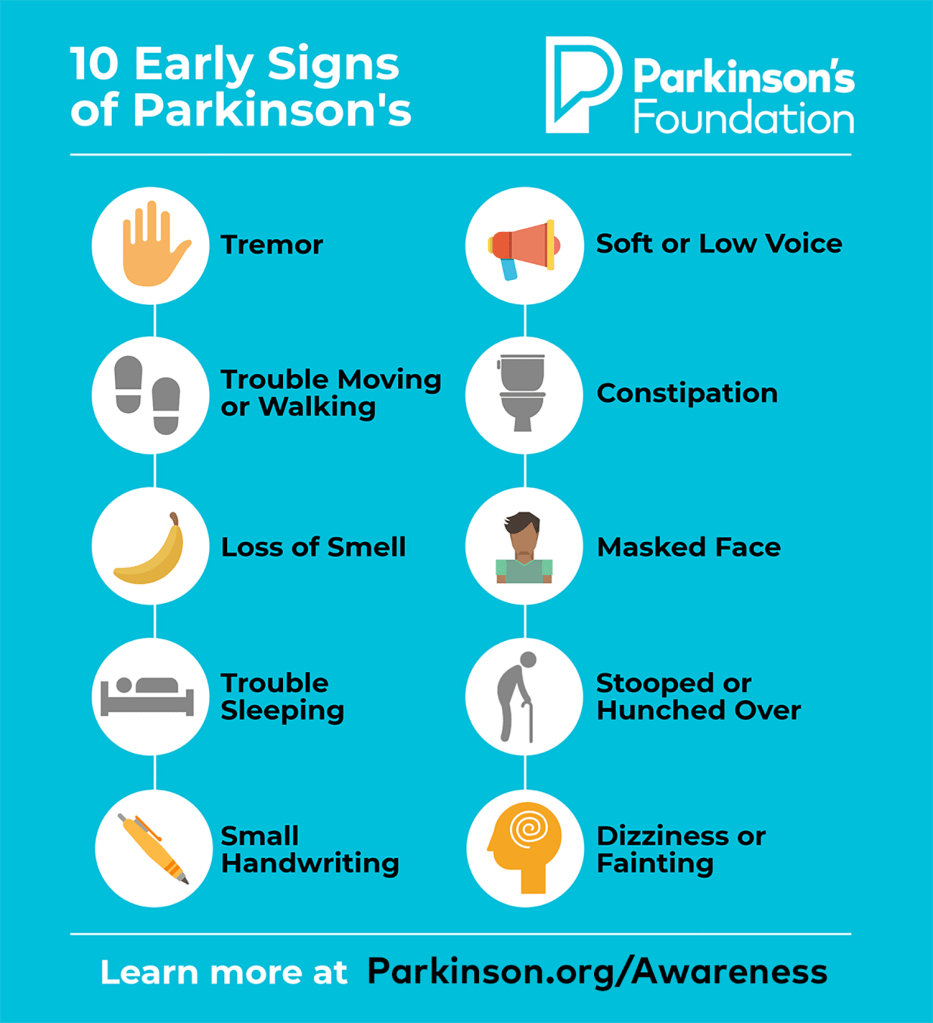
Dr. Ahmed says PD requires a clinical diagnosis and might be suspected in a patient with a frequency of falls. He said other symptoms are the presence of tremors, rigid movements, or “bradykinesia,” which is a slowness in movement.
“We always want to rule out other causes,” Dr. Ahmed says. “There are other medical conditions which can mimic symptoms of Parkinson’s.”
“Whenever the diagnosis is made, a neurologist will evaluate for other conditions to see if they are missing anything.” He says this could include imaging tests.
“Parkinson’s has two components to it,” Dr. Ahmed explains. “There’s a movement disorder for the patient and then there is non-motor dysfunction.” Dr. Ahmed says the non-motor can actually impair your automatic control of bodily functions. “It can include your bowel function and even the sweating function.”
Dr. Ahmed says PD is one of the more common neurodegenerative diseases which also includes Alzheimer’s Disease or dementia. He explains that neurodegenerative disease “happens over a period of time because of a debt of neurons that progress over a period of time and become more severe.”
Neurons send messages throughout the body allowing it to function. It includes everything from breathing to talking, eating, walking, and thinking. The National Institute of Neurological Disorders and Stroke has a very easy-to-comprehend website (ninds.nih.gov) which helps explain the life and death of a neuron.
Dr. Ahmed says that neurodegenerative disorders can be caused by many factors such as traumatic or recurring head injuries over a period of time, as well as exposure to toxins such as certain pesticides or other toxins. “So we think it’s multi-factoral and not just one thing that starts the process over a period of time,” he explains.
Hope for PD sufferers
“The thing about Parkinson’s, is when it hits at its peak, the patient realizes life is so limited for them because they cannot move around freely, they have more falls, and all those things they are suffering with,” says Dr. Ahmed. He explains that he starts patients on medication, which when it works, allows the patient to feel much better.
He says managing the disease also requires patients taking care of themselves and by not doing so it can adversely impact the prognosis of the disease.
“If they don’t take care of themselves by changing their habits, and lifestyle, and exercise, the medication sooner or later will stop working and they will need more medications until they reach the peak of medication doses,” he says.
Once a patient reaches that peak, Dr. Ahmed says things can take a turn for the worse, causing a patient’s abilities to become limited.
Dr. Ahmed stresses that diagnosing the disease sooner rather than later, and following recommended protocols can be the hope a PD patient needs to maintain their quality of life and prolong becoming disabled by the disease, as well as prolonging their life expectancy.
Additional hope comes by way of more medications and options becoming available. Dr. Ahmed explains there are even different medication delivery mechanisms available now to help patients who have difficulty swallowing or who cannot otherwise tolerate oral medications.
He explains the medications used to treat PD are trying to regulate dopamine in the body in one way or another. Dopamine, a neurotransmitter, is a chemical messenger that plays a crucial role in various bodily functions including movement. Dr. Ahmed says once dopamine is deficient, movement starts to decrease.
There are also more and more surgical options becoming available to help in the fight against PD according to Dr. Ahmed. He further explains that the delivery of medications is evolving with the use of a subcutaneous pump as well as a treatment using an intestinal tube.
“Parkinson’s Disease in the long run does reduce the lifespan,” Dr. Ahmed says, clarifying that it’s not typical to be able to interpret just how the disease will progress in a particular patient since the progression is different for everyone.
He stresses early diagnosis and the patient’s self care as being the main factors that can help prolong a PD patient’s lifespan which he says can be 20-30 years after diagnosis. He added that for a person who is diagnosed at the typical age range of age 60-70, that is an average life expectancy. Dr. Ahmed said the way PD progresses in the body, it can lead to dementia, affect swallowing, and increased falls.
Dr. Ahmed reiterates that with proper treatment and self care, it is possible for a PD patient to stay independent for several years. There may not be a cure yet but he says there is hope with these newer medications and technologies. ν
Note: It’s important to consult with your healthcare professional before making any significant changes to your physical routine or diet, especially if you have any underlying health conditions.
Dr. Ausaf Ahmed is board-certified in neurology. He provides specialty care for patients suffering from acute strokes, common movement disorders, Multiple Sclerosis, dementia, headache syndromes, seizure disorder, neuro-muscular conditions, and more. He attended medical school at Ziauddin Medical University in Karachi, Pakistan, completed his residency at the University of Toledo Medical Center in Toledo, Ohio, and completed his fellowship at The Mayo Clinic in Rochester, Minnesota. Learn more at Lakecumberlandhospital.com. For more information about Parkinson’s Disease, visit parkinson.org or michaeljfox.org.

 Compass Communications