There are many good reasons to have your hearing checked regularly, and Beltone’s Rob D. Moore, BC-HIS (Board Certified Hearing Institute Specialist) tells us that regular hearing tests can help establish a baseline to chart and compare potential hearing loss over time.
“I’d like for everyone to get their hearing checked, even if they don’t have any problems,” Rob said. “You can start to lose your hearing and not even realize it.”
Although the testing methods have remained fairly consistent over the years, the technology to help track and treat hearing loss for the 13.3% of Americans estimated to be inflicted with the disorder, sounds almost space-aged. We’ll take a look at one revolutionary device in a moment.
First, Rob breaks down the basic types of hearing loss. The type you or a loved one might experience depends on what part of the ear is involved. The three main types of hearing loss are sensorineural, conductive, and mixed.
Sensorineural
Sensorineural is the most common type of hearing loss which Rob says can be noise induced or age-related. With this type of hearing loss, sounds can be diminished in volume or become distorted.

The ability to hear high-pitched sounds is usually affected first. An individual may be able to discern that someone is speaking but not be able to hear well enough to understand what is being said.
“They don’t necessarily need something to be louder, they just need it to be more clear to understand,” Rob explained.
With sensorineural hearing loss, Rob said tinnitus (ringing in the ears) can also develop.
Conductive
A conductive hearing loss generally means there is something physically wrong. Conductive hearing loss stems from problems in the outer or middle ear.
“Whenever we do a hearing test, we do air (or pure tone) testing which involves headphones over the ear. If there’s a large gap between air and bone, I’m sending this person to the doctor. We’re going to make sure they’re physically okay.”
Otosclerosis is an abnormal bone development in the middle ear.
Allergies, sinus problems and certain medications can also lead to a temporary diminishing of one’s hearing ability.
Mixed
Mixed hearing loss is precisely what it sounds like: a mix of both conductive and sensorineural hearing loss.
In these cases, treatment may require a multi-pronged approach, such as wax removal, medication or surgery, in addition to the hearing aids recommended by a hearing care professional.
How common is hearing loss?
The Kentucky Commission on the Deaf and Hard of Hearing estimates about 10,000 Pulaski Countians are deaf or hard of hearing.
Nationally, about 15 percent of American adults aged 18 and over report some trouble hearing, according to the National Information Center on Deafness and Other Communication Disorders.
Rob cited a study from January 2023 by researchers at the Johns Hopkins Bloomberg School of Public Health which found older adults with greater severity of hearing loss were more likely to have dementia, but the likelihood of dementia was lower among hearing aid users compared to non-users.
Accepting hearing loss
“People don’t want to admit they have a hearing problem,” Rob said. “That’s half the battle.”
Rob said from his experience, fitting someone with hearing aids can result in a complete turn around in personality and mood.
It’s not uncommon to experience feelings of grief when diagnosed with hearing loss, according to HealthyHearing.com.
The site recommends finding support from family, friends and hearing loss groups to help find community and accept the hearing loss. The use of hearing aids can keep you connected and improve your overall health and well-being.
Protecting your hearing
Rob said Beltone can also help protect hearing with custom ear plugs. These can be beneficial for those who hunt, do target practice, or have other noise exposure, such as musicians.
“It’s good to have ear plugs to prevent hearing loss,” Rob said.
- Custom ear molds can be made for earphones to block outside noise.
- The Centers for Disease Control and Prevention offer these hearing protection tips:
- Avoid or limit exposure to excessively loud sounds.
- Turn down the volume of music systems.
- Move away from the source of loud sounds when possible.
Use hearing protection devices when it is not feasible to avoid exposure to loud sounds or reduce them to a safe level.
Advanced technology
“Beltone and other manufacturers are doing a lot of research and development on how to make things sound more natural,” Rob said of hearing aids.
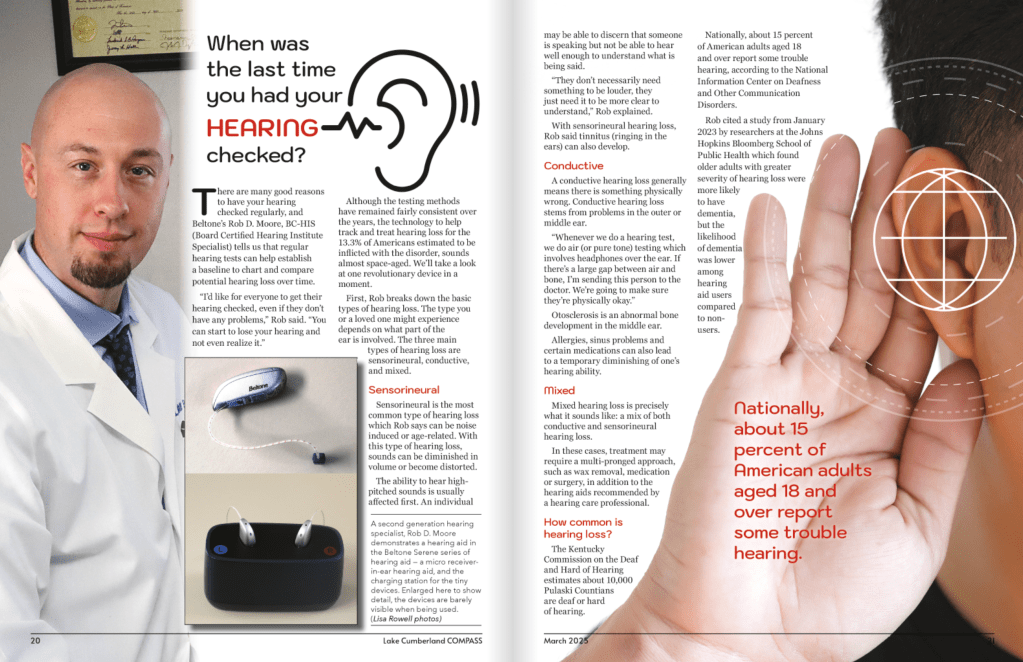
Beltone’s Serene series of hearing aids are barely noticeable and have remarkable abilities to detect speech and lower noise. They are self-adjusting and rechargeable.
The tiny but powerful device can also help with tinnitus.
“What’s always been a problem with hearing aids is speech and noise,” Rob said. He explained that older hearing aids weren’t as technologically advanced at distinguishing noise from speech. For example, while trying to listen to a person speaking, the hearing aid could be amplifying the sound of the refrigerator running in the next room.
“They’ve gotten a lot smaller and a lot more comfortable,” he said of current hearing aids. “You basically have two computers in your ears,” he said of the self-adjusting technology.
Get checked
Rob emphasizes the importance of getting your hearing checked, even if you do not think you have any hearing loss. Establishing that baseline can make a difference down the road. Many places, such as Beltone, offer free hearing tests. ν
Fortunately, there are resources available to help understand and manage hearing loss. For more information and Kentucky resources, visit kcdhh.ky.gov/pr/poc.html

 Compass Communications