By Lisa Rowell
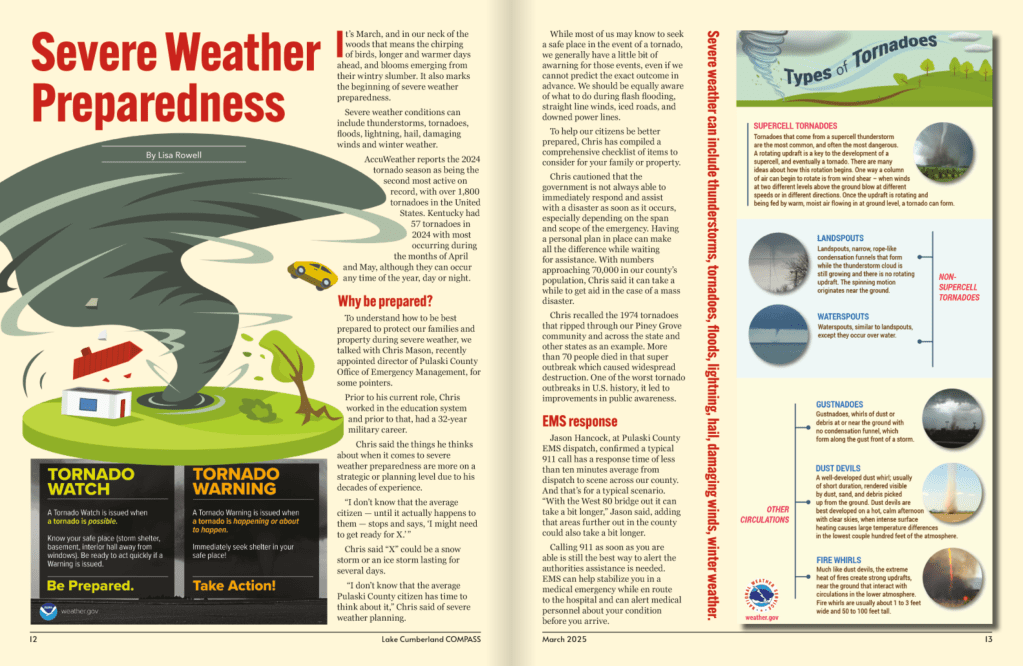
It’s March, and in our neck of the woods that means the chirping of birds, longer and warmer days ahead, and blooms emerging from their wintry slumber. It also marks the beginning of severe weather preparedness.
Severe weather conditions can include thunderstorms, tornadoes, floods, lightning, hail, damaging winds and winter weather.
AccuWeather reports the 2024 tornado season as being the second most active on record, with over 1,800 tornadoes in the United States. Kentucky had 57 tornadoes in 2024 with most occurring during the months of April and May, although they can occur any time of the year, day or night.
Why be prepared?
To understand how to be best prepared to protect our families and property during severe weather, we talked with Chris Mason, recently appointed director of Pulaski County Office of Emergency Management, for some pointers.
Prior to his current role, Chris worked in the education system and prior to that, had a 32-year military career.
Chris said the things he thinks about when it comes to severe weather preparedness are more on a strategic or planning level due to his decades of experience.
“I don’t know that the average citizen — until it actually happens to them — stops and says, ‘I might need to get ready for X.’ ”
Chris said “X” could be a snow storm or an ice storm lasting for several days.
“I don’t know that the average Pulaski County citizen has time to think about it,” Chris said of severe weather planning.
While most of us may know to seek a safe place in the event of a tornado, we generally have a little bit of awarning for those events, even if we cannot predict the exact outcome in advance. We should be equally aware of what to do during flash flooding, straight line winds, iced roads, and downed power lines.
To help our citizens be better prepared, Chris has compiled a comprehensive checklist of items to consider for your family or property.
Chris cautioned that the government is not always able to immediately respond and assist with a disaster as soon as it occurs, especially depending on the span and scope of the emergency. Having a personal plan in place can make all the difference while waiting for assistance. With numbers approaching 70,000 in our county’s population, Chris said it can take a while to get aid in the case of a mass disaster.
Chris recalled the 1974 tornadoes that ripped through our Piney Grove community and across the state and other states as an example. More than 70 people died in that super outbreak which caused widespread destruction. One of the worst tornado outbreaks in U.S. history, it led to improvements in public awareness.
EMS response
Jason Hancock, at Pulaski County EMS dispatch, confirmed a typical 911 call has a response time of less than ten minutes average from dispatch to scene across our county. And that’s for a typical scenario. “With the West 80 bridge out it can take a bit longer,” Jason said, adding that areas further out in the county could also take a bit longer.
Calling 911 as soon as you are able is still the best way to alert the authorities assistance is needed. EMS can help stabilize you in a medical emergency while en route to the hospital and can alert medical personnel about your condition before you arrive.
Chris agrees, education is key to being prepared
“We as the OEM office and as the county government have a responsibility to prepare the county as best as we can for an impending event,” Chris said.
“One of the initiatives for this office is going to be to push that information out there.” Although Chris understands not everyone may act on the message, he thinks it’s possible to reach the majority.
“If we save one life by doing this, then we’ve achieved what we’ve set out to, and obviously to save more.”
“What I want people to understand,” Chris urged, “is that we’re not going to NOT take care of you but it starts with YOU.”
Chris hopes the following “tool kit” of resources will help empower our community members to feel better prepared for any disaster, weather-related or otherwise.
Pre-storm exterior prep
- Clean gutters: Regularly clear debris from your gutters to prevent water damage from overflow
- Trim trees: Prune branches that could fall on your house during a storm.
- Secure loose items: Bring in or secure outdoor furniture, garbage cans, and other loose objects that could blow away.
- Check drainage: Ensure proper grading around your house to direct water away from the foundation.
Home improvements
- Upgrade roof: Consider inspecting and repairing your roof to ensure it can withstand strong winds and heavy rain.
- lnstall storm shutters: Add storm shutters to windows for added protection.
- Backup power: Consider a generator or battery backup system to power essential appliances during power outages
Emergency preparedness
- Emergency kit: Assemble a kit with non-perishable food, water, first aid supplies, flashlights, batteries, important documents, and medications.
- Communication plan: Discuss evacuation plans with your family and designate a meeting point outside your home,
- Pet plan: Determine where you will take your pets if you need to evacuate and have necessary supplies ready.
Stay informed
- Weather updates: Monitor weather forecasts regularly and heed warnings from local authorities.
- Weather radio: Consider having a weather radio with battery backup to receive emergency alerts.
- Be weather-ready: Check the forecast regularly to see if you’re at risk for severe weather, Listen to local news or a NOAA weather radio to stay informed about severe thunderstorm watches and warnings. Check the Weather Ready Nation for tips.
- Sign up for notifications: Know how your community sends warning. Some communities have outdoor sirens. Others depend on media and smart phones to alert residents to severe storms, such as the Code Red app.
- Create a communications plan: Have a family plan that includes an emergency meeting place and related information. Pick a safe room in your home such as a basement, storm cellar or an interior room on the lowest floor with no windows. Get more ideas for a plan at ready.gov/make-a-plan.
- Practice your plan: Conduct a family severe thunderstorm drill regularly so everyone knows what to do if a damaging wind or large hail is approaching. Make sure all members of your family know where to go when severe thunderstorm warnings are issued. Don’t forget pets if time allows.
- Prepare your home: Keep trees and branches trimmed near your house. If you have time before severe weather hits, secure loose objects, close windows and doors, and move any valuable objects inside or under a sturdy structure.
- Help your neighbor: Encourage your loved ones to prepare for severe thunderstorms. Take CPR training so you can help if someone is hurt during severe weather.
Water
- One gallon per person per day for three days.
- Store in airtight plastic containers for easy access.
Food
- Three-day supply of non-perishable foods.
- Check out Camping Cooks’ emergency food guide: Eating and Cooking When the Power Goes Out.
- Remember to include pet food
First aid
In an emergency, injuries may occur. A well-stocked first aid kit can prevent minor injuries from becoming major issues. You may want to take a basic first aid class though the American Red Cross or online through the National Safety Council.
Basic first aid items in your kit:
- Sterile gloves
- Sterile dressings
- Soap and antibiotic towelettes
- Antibiotic ointment
- Adhesive bandages in a variety of sizes
- Eye wash solution
- Thermometer
- Prescription medications you take every day
- Prescribed medical supplies such as glucose and blood pressure monitoring equipment and supplies
- First aid book
- Non-prescription drugs (aspirin or non-aspirin pain reliever, anti-diarrhea medication, antacid, laxative)
Sanitation
Adequate sanitation is a significant environmental concern after a disaster. When sewer pipes are damaged or the sanitation system goes off-line, entire communities, including people and habitats are at risk. Be prepared to take care of your waste for the same period of time as you’ve prepared food and water. A basic sanitation kit should include:
- Toilet paper
- Soap
- Feminine supplies
- Plastic garbage bags & ties
- Plastic bucket with tight lid
- Chlorine bleach
- Supplies for pet waste
Tools and supplies
What you need can vary greatly based on where you live, the type of disaster you expect and your family unit. Talk with your family about items they wouldn’t want to be without in an emergency.
Here are some basic items that most people will need in a disaster:
- Wrench to turn off gas and water
- Cups, plates and utensils (raid your camping gear to save money —just don’t forget to replace them after each trip)
- Light source (solar is best so you don’t have to worry about batteries)
- Radio (get one that is USB powered, check out solar options, or buy a battery-operated radio and extra batteries)
- Manual can opener or utility knife
- Small fire extinguisher
- Pliers
- Duct tape
- Matches in a waterproof container
- Plastic storage container to keep everything in one place
Documents
In preparation, scan valuable documents and store them securely online so they can’t be ruined by a disaster. It may be helpful to have copies of key items (like insurance cards, social security number, passwords and insurance policies) in your kit as well. Take short videos to catalogue valuables in your home, such as vehicles, computers, furniture and artwork, for insurance purposes.
Key documents include:
- Will, insurance policies, contracts, deeds
- Passports, Social Security cards, immunization records
- Bank account numbers
- Credit card account numbers and companies
- Family records (birth, marriage, death certificates)
Older adults
Finally, being disaster-ready requires additional accommodations for older adults. Visit the National Council on Aging’s website (ncoa.org)for more resources for older adults.
 Compass Communications