Rates 5 out of 5 stars
By Lisa Rowell
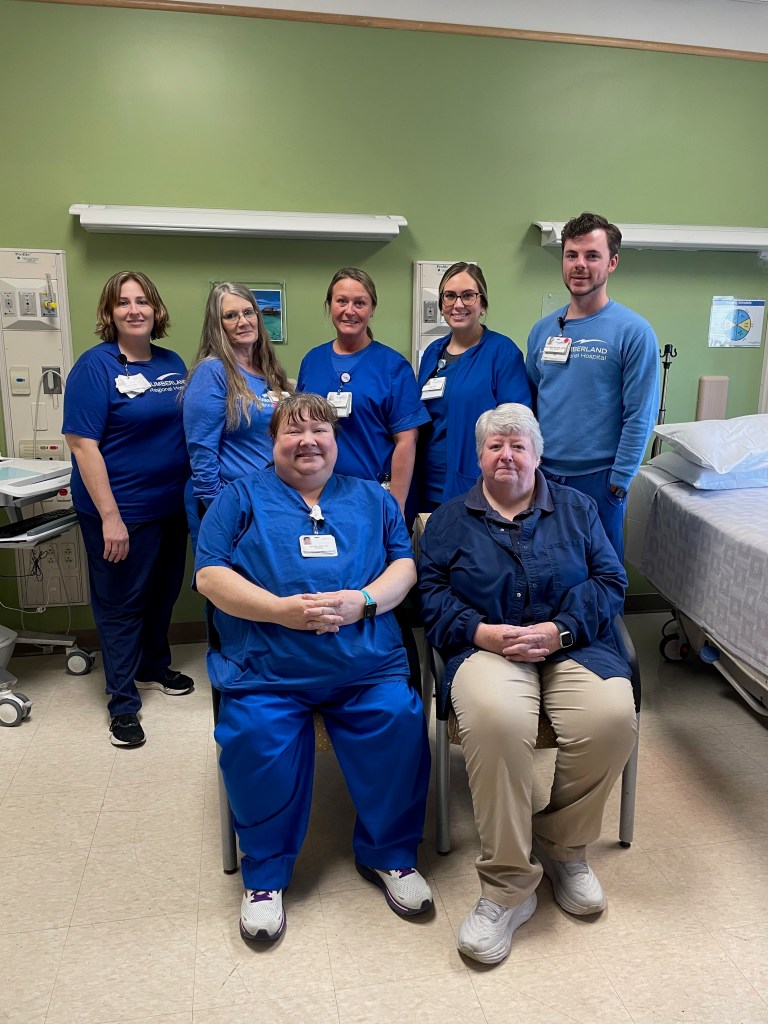
Staff at Lake Cumberland Regional Hospital’s Special Care Unit includes (standing, l-r:) Angela Stogsdill, OT/RN, 16 years; Tammy Roberts, RN, 21 years; Tabitha Bryant, RN, 2 years; Hayley Fent, RN, 1-5 years; Zach Coffey, MSN, RN, RHIA, CPPS, 2 years; (sitting) Jennifer Goode, BSN, RN, 24 years; and Annette Welley, RN, 17 years. The unit has about 40 staff members. (Lisa Rowell photo)
Located on the third floor of Lake Cumberland Regional Hospital, the Special Care Unit (SCU) is designed as a short-stay rehabilitation center for patients who are not strong enough to go home after their hospital stay. Should you or a loved one require skilled nursing care before returning home from a long illness, surgery, or injury, U.S. News & World Report has rated the unit as high as such a facility could possibly be rated with five out of five stars. The ranking is based on quality measure scores from the The U.S. Department of Health and the Centers for Medicare and Medicaid Services (CMS) which strictly regulate skilled nursing services. Only accredited facilities can provide these services.
Skilled nursing
The SCU is a skilled nursing facility within the hospital. To understand more about the unit, let’s first explore what skilled nursing involves.
A skilled nurse is a licensed health professional who provides advanced medical care and therapy to patients who need a higher level of care than general nursing. They are highly trained and certified to provide specialized care, providing a wide range of services and therapy.
Skilled nurses work in different settings, including skilled nursing facilities (SNFs), nursing homes, clinics, or patient’s homes. They care for patients requiring post-surgical care, chronic condition management, acute illness recovery, rehabilitation after a stroke or other conditions
Care on the SCU unit may include rehabilitative services from licensed physical, occupational or speech therapists.
A skilled nursing facility provides transitional care for patients with the goal of being well enough to go home.
LCRH’s SCU
To understand more about the skilled nursing facility within Lake Cumberland Regional Hospital (LCRH), we talked with Zach Coffey, MSN, RN, RHIA, CPPS, Director, Inpatient Rehab, Cardiac Rehab, and Special Care Unit.
Zach is a registered nurse, with a Master of Science in Nursing. He is a registered health information administrator with a certified professional inpatient safety credential.
The SCU is a 12-bed skilled nursing facility within the hospital that is licensed the same as a nursing home. Zach explained that while the unit is owned by the hospital, it is in fact its own entity which is comprised of ten private rooms and one shared room.
Zach said the main difference between the SCU within LCRH and a traditional nursing home is that it is geared toward short-term stays. “People don’t come here to live. Our average stay is 14-20 days,” he said. He added that there are instances (insurance permitting) where patients may need to stay a bit longer, especially if they have made great progress on the unit and are expected to continue on that trajectory before returning home.
“The majority of our patients do get to return home,” Zach said.
“Our main purpose is to provide a rehabilitation in the style of a nursing home.”
The in-patient rehabilitation unit is on the same floor as the SCU, lending easy access to SCU patients who receive therapy every weekday which can include physical, recreational, speech and/or occupational.
Within that average 14-20 day stay on the unit, nearly 70 percent of patients are able to return home after their stay. A traditional nursing home is geared more toward long-term residential care.
Zach, who has been with LCRH for more than two years, said there are about 40 staff members who work on the unit. The unit sees low turnover of its nursing staff. “We just had a nurse retire after 38 years,” Zach said.
Earning five stars
“One of the things that sets us apart when it comes to statistics for us getting this designation, is that our nursing staff spend an average of six hours and 45 minutes per resident per day,” Zach said. The average in similar facilities in Kentucky is almost half that amount of time.
Zach said this valuable time with the patients attributes to the high success rate of 67.8 percent of patients being able to return home after their stay. This far exceeds the 47.1 percent average in Kentucky and the 50.4 percent national percentage.
Where falls can be problematic in nursing homes, the SCU had zero falls resulting in injury which also contributed to the high rating by U.S. News and World Report.
Caring for patients
Patients who come to the unit are mostly seniors who have been in a hospital setting and required therapy in a skilled nursing setting prior to their release. They might be referred by their surgeon or by a hospitalist.
“Common patients are from what we call critical illness myopathy,” Zach said, explaining that CIM is a weakness after being ill for an extended period of time. This can include muscle weakness in the limbs, trunk, or respiration. Zach said other patients on the unit can be “post fracture patients or those requiring significant wound care needs or long-term IV antibiotics which cannot be managed at home.”

Zach added that it can be common for someone of advanced age to become weak after an illness. “They can’t just go straight home [from the hospital setting] and this is a bridge to that,” he explained of the unit’s purpose. It can be more common than one might imagine for our elders to not have family or caregiver support at home but who are not ready for a long-term nursing home environment.
Zach said patients are on the unit long enough to develop a rapport with the staff and are able to leave their rooms and take part in group therapy and communal dining. Patients can also take part in activities with a state-certified activities director.
“We have our own dedicated social worker who is dedicated to admissions and discharge,” Zach said of the unit.
The beds on the unit tend to stay full for the most part. “There’s never a lack of people interested,” Zach said.
The 2023 U.S. Census reported just more than 20 percent of Pulaski Countians are age 65 or older. Considering seniors may have a more difficult time bouncing back from an illness or injury and many may not have adequate support at home, having this highly rated unit right here in our community can be a blessing for many.
The data doesn’t lie
“We are obligated to report lots of quality data to CMS,” Zach explained. “We are also one of the only five-star rated CMS facilities in the state,” he said. “U.S. News and World Report gathered their data based off that CMS rating,” he said. “The data doesn’t lie, and they do audit us.”

U.S. News & World Report has been dedicated to helping consumers make important decisions in their lives using world-class data and technology to publish independent reporting, rankings, journalism and advice for more than 90 years.
Good leadership
When asked about the transition to a new CEO at LCRH, Zach expressed appreciation for Carolyn Sparks, who took on the role in August of 2024, as well as for outgoing CEO Robert Parker. “Carolyn is the most down to earth and understanding CEO I’ve ever worked with,” Zach said. “She definitely has a good ability to connect with all types of people including patients, staff, and nurses. I think that speaks highly of her because you feel immediately at ease when you’re around her. Aside from that, she’s incredibly intelligent when it comes to hospital operations,” Zach said.
“I think she promotes a really healthy culture within the organization.”
Medicare.gov ranks LCRH’s Special Care Unit as “much above average,” earning five out of five stars. This overall rating was based on health inspections, staffing, and quality measures. The average number of hours a registered nurse spends with a patient is four hours, 37 minutes — far exceeding the national average of only 40 minutes. The Kentucky average is only 44 minutes.
Read the report here.

 Compass Communications