Story by Eli Parker
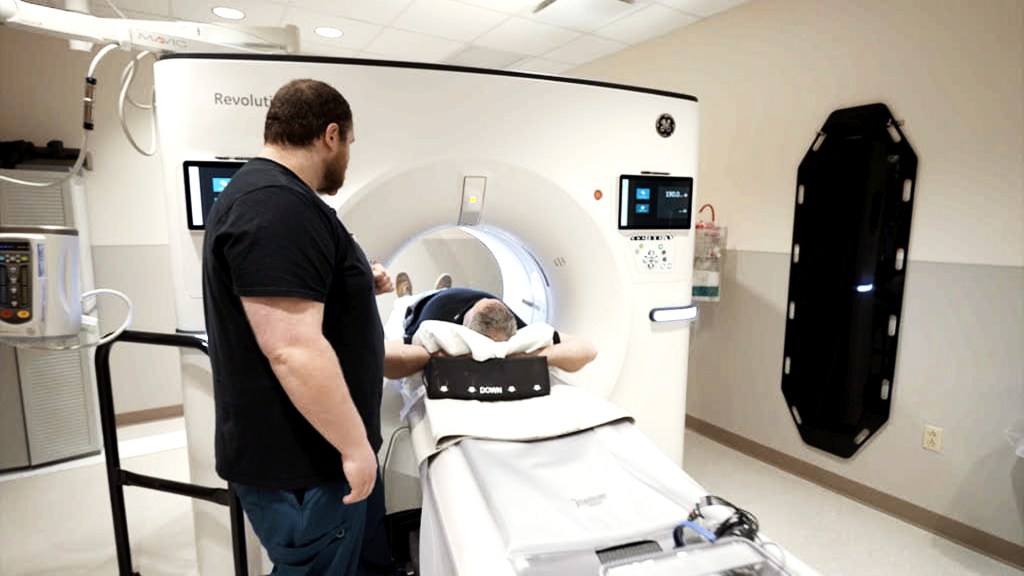
Nathan Bennett, FACHE, CPPS, RT, Senior Director of Imaging Services at Lake Cumberland Regional Hospital, demonstrates the CT256 scanner. (Submitted photo)
Breathing is essential in our everyday lives. Even without thinking, our bodies instinctively make us breathe in oxygen to convert into energy while also releasing the waste gas that is carbon dioxide. However, there’s a disease that continues to put this basic necessity at risk — lung cancer.
Through a rapid growth of cells within the lungs, this disease causes damage to healthy lung tissue, which is needed for proper breathing. According to the Kentucky Department for Public Health’s Lung Cancer Program, lung cancer is the leading cause of cancer deaths for both men and women and is the third most common cancer in the state. In 2020, 4,572 diagnoses in Kentucky alone were documented in the KY Cancer Registry.
Nonetheless, the fight against lung cancer continues to be an ongoing battle. Active in these efforts is Nathan Bennett, FACHE, CPPS, RT (R), (CT); who serves as the Senior Director of Imaging Services at Lake Cumberland Regional Hospital. From his extensive career, Bennett has learned that the best means of combating this disease is by either avoiding risk factors in the first place or catching signs as early as possible.

“Of course, the primary driver of lung cancer is smoking,” Bennett stated, as smoking accounts for 80-90 percent of lung cancer deaths in the United States. This is very much prominent for Kentucky, as it lies in the “Tobacco Nation” of the country where percentages of smoking are at their highest. Records also show that Kentucky was historically the first in the nation for adult smoking.
The second leading cause is exposure to radon – a harmful gas that naturally comes up from the ground. This typically takes place in basements or homes that are built lower into the ground. It’s recommended for homeowners in these circumstances to invest in radon mitigation systems that pull the gas away from the floors and exhausts it outside.
Other risk factors include exposure to secondhand smoke or to air pollution, particularly from vehicle exhaust, coal-fired power plants, and other industrial sources.
Of course, it’s highly recommended to avoid these health risks in the first place. However, for those that find themselves regularly exposed to these risk factors, the next step is to get tested as soon as possible through the nonlethal examining procedure that is a CT scan. If affording to do so is a worry, insurance companies typically cover annual screenings if a patient meets the right requirements.
Bennett not only recommends getting screened early from a professional standpoint, but from his own life experience with a family member. “My stepmother’s life was saved by this scan about fifteen years ago,” he said. “She went out with my dad and he was getting his screening. She decided to get a screening just because she was there, even though she had been smoking less at that time. Dad was fine, but her results came back with a really small nodule that was a lung cancer in her right lower lobe. She had surgery, and fifteen years later, she’s okay.”
When caught in the early stages (Stages 1 and 2), the means of treatment and their efficiency are much greater. “The data’s already showing, very clearly, if you catch it in Stages 1 or 2, you have a completely different outlook on resolving the problem,” Bennett adds. With an early diagnosis and treatment, cure rates can be as high as 80-90 percent.
Once diagnosed, a biopsy examination will determine the best means of treatment, whether it be surgery, radiation treatment, or chemotherapy. No matter the procedure, the end results often look promising for those that recover from these treatments.
“The good thing about your lungs is that there’s two of them,” Bennett explains. “Within each one of those two lungs, you have a couple of lobes, so, a lot of times, they can take a lobe out of a lung and you will get to keep the rest of that lung and the other full one too. Some people can remove an entire side of a lung and you still have a whole other lung. People can live just fine with one lung.”
“The lungs are a very regenerative organ,” he adds. “If given time, a lot of them can actually revert to close to those of a nonsmoker, but it’s all about quitting smoking early or not smoking at all.”
However, when a patient reaches the later stages of lung cancer (Stages 3 and 4), it becomes more about life extension. From Bennett’s point of view, when patients start uncovering symptoms, it often means they’re past the point of being cured. “It’s not saying you can’t be cured or you can’t be treated,” Bennett adds, “but it’s a harder battle to fight than when you’re in Stages 1 or 2.”
These symptoms include shortness of breath, difficulty breathing, and continuous habits of coughing, sometimes to the point of coughing up blood. There are also cases of those that show no symptoms, further emphasizing the importance of early screening.
Despite the continuing gloom brought by lung cancer, recent years have shown that the fight against it grows resilient and effective. In 2023, the American Lung Association reported that Kentucky was ranked the second in the nation for lung cancer screenings. Throughout these efforts, it’s always been about educating the public and getting them connected to the resources they need. ν
Join Lake Cumberland Regional Hospital at 305 Langdon St., Somerset, Ky., for National Lung Cancer Screening Day on Saturday, November 9, from 8 a.m. to 12 noon. Enter through the main lobby of the hospital by the registration desk. Refreshments will be available, and educational information will be provided by the Kentucky Cancer Program to help spread knowledge on lung cancer prevention and early detection. Early detection saves lives, and we’re making screenings more accessible to those who can’t schedule them during the week. To schedule your screening, call (606) 451-3787.
You must have an established primary care provider or pulmonologist. If you need a provider, call (800) 424-DOCS.

 Compass Communications