And a wag of a tail
Shelly and Rick Cook welcomed Gretta the Labradoodle into their family in March. It was a special connection and perhaps even a match made in heaven for the trained service dog and her new handler.
It was no easy road, however, for Gretta to take the journey into becoming a service dog. Months of preparation, careful consideration, and intense training went into her eventual placement with the Cooks.
With Shelly’s visual impairment, having a dog that could assist her and help keep her safe made perfect sense.
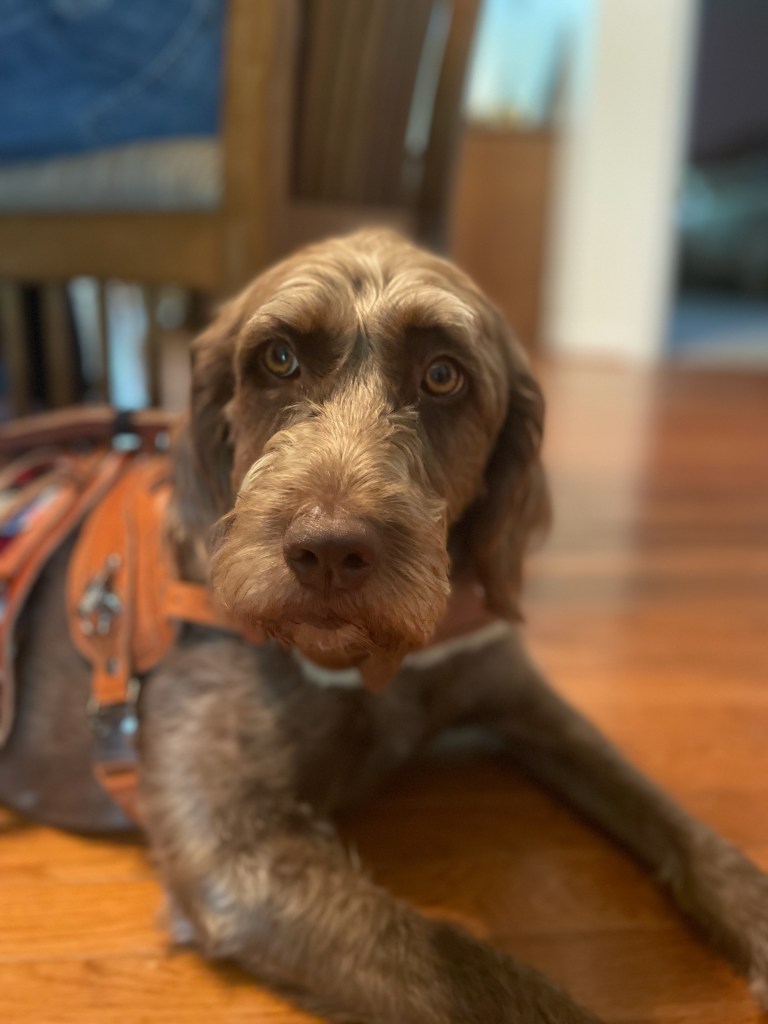
The training was not all on Gretta’s part. Shelly and Rick both took part in classes to be sure they were getting the most out of Gretta’s services and learned how to properly give her commands.
Liz Norris of Pawsibilities Unleashed, located in Frankfort, oversaw Gretta’s training and placed the dog with the Cooks.
Liz said, “We use force-free, positive reinforcement training methods in our programs to help build a trusting relationship with your dog so your dog will want to work for you.” She said through the program, they also train the people (handlers) to work with their new service dog to help continuously enhance its service skill set. This allows them to adapt to changing needs for a lifetime of service.

Not for everyone
Liz stressed that service dogs are not the right intervention for everyone. “It takes a lot of learning, knowledge, and work on the handler’s part after they get a trained service dog. How much effort they put into learning the dog’s commands and hand signals, how consistent they are, how bad they really want a 24/7 sidekick, all comes into play. I’ve seen miracles happen and I’ve seen failures happen. Having a service dog is not for everyone.”
Furry blessing
Having Gretta come into their lives was a blessing for Shelly, and a comfort for Rick, knowing his wife would be safe in the dog’s presence.
In the early days of their training sessions with Gretta, The Cooks were able to witness first-hand, other service dogs in action, doing exactly what they were trained to do.
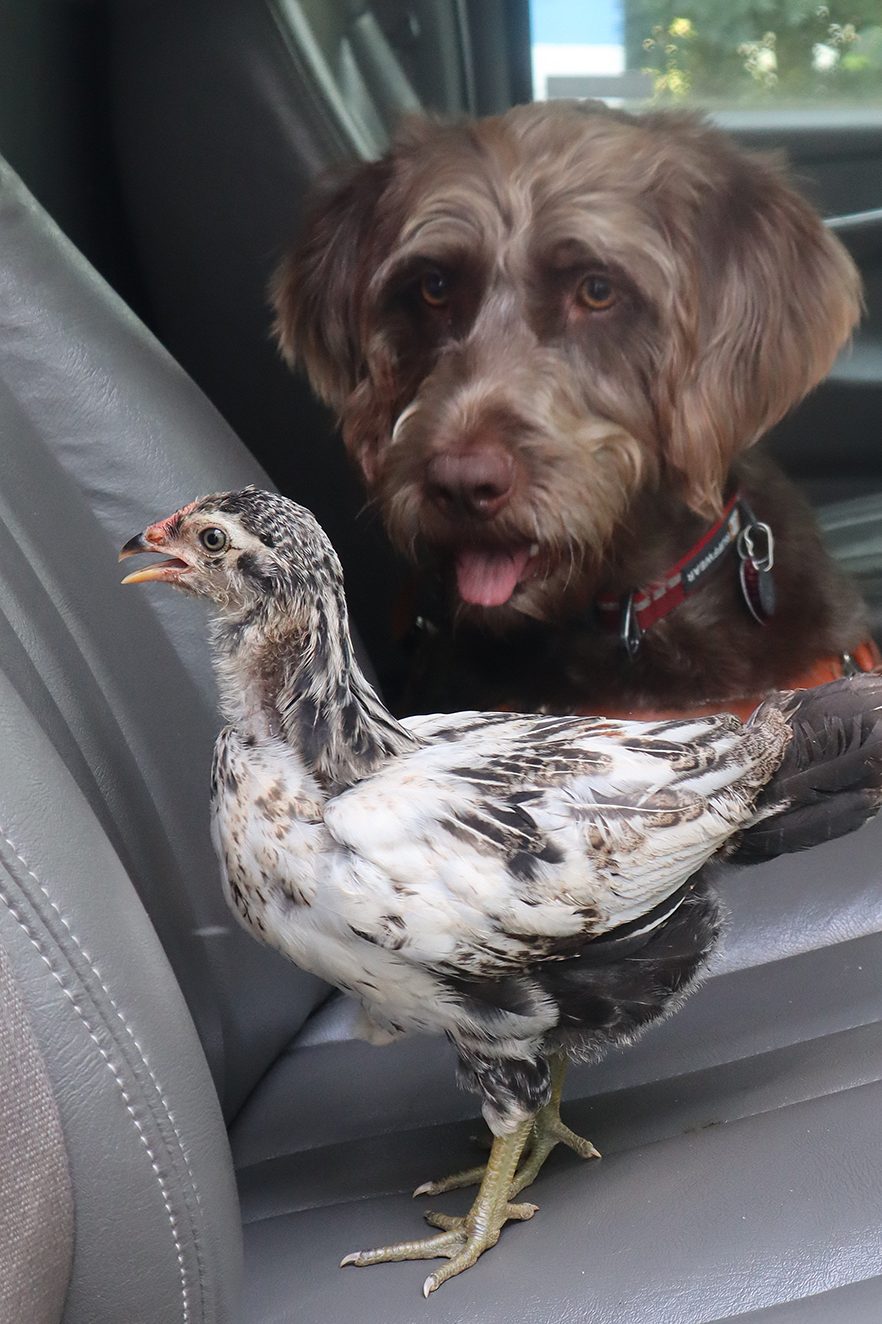
Once the harness is on, it’s go-time for Gretta. Should Shelly become separated from Rick in a public place, Gretta will find him — which happened at the mall one day before they had Gretta. She’ll find a public restroom, she’ll find the family’s car. She can even be trained to locate different cars. She can find any exit. She will also leave Shelly’s chickens and ducks alone, which was very important for the Cooks. Gretta is constantly learning. Should Shelly fall, Gretta knows how to safely help her back up.
That’s some impressive work for a three-year-old Labradoodle. And she does it with a wag of her tail.
It was a lot of training for Gretta as well as for the Cooks who had to study and learn Gretta’s commands.
Liz said because Gretta is a mobility service dog, she is trained to stand as a default. She will stand on a specific spot on command until she is released.
The search
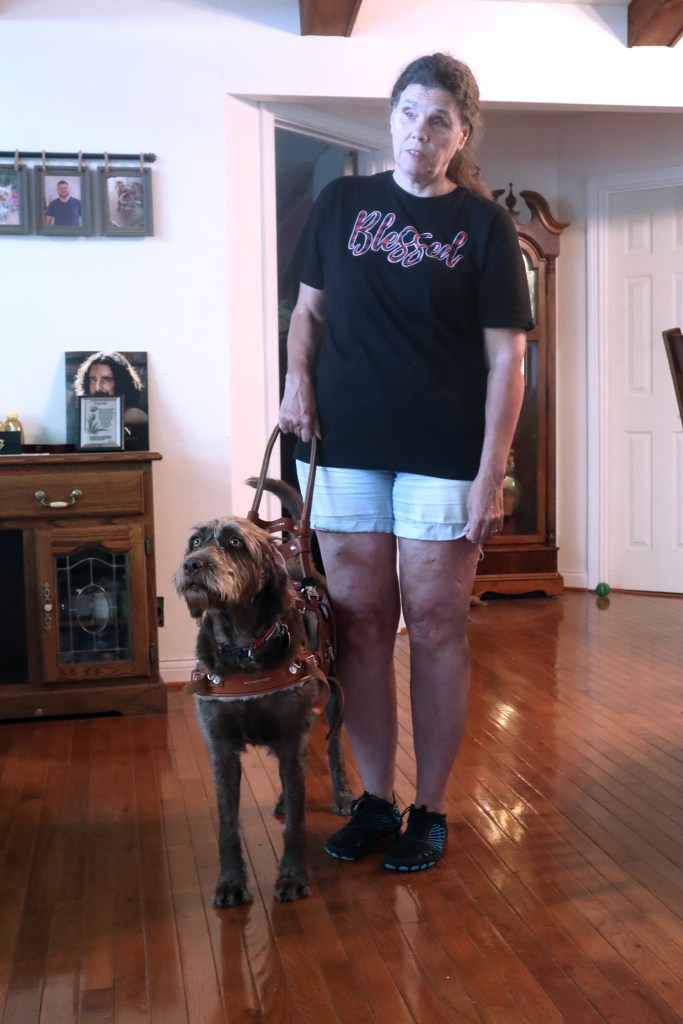
While service dogs are generally trained to be on the left side of their handler, Shelly needed a dog that could be trained for her right side, since she has no vision in her right eye and limited vision in the left.
Liz said this allows Gretta to “block” and be Shelly’s eyes for her where she’s needed most.
“We’re talking about being very selective here,” Liz said of the requirements the Cooks had for a service dog. Finding a dog with no prey drive wasn’t going to be an easy task.
Rick said the size of the dog was also a factor.
The Cooks met Gretta, and it was instant love for Shelly. Liz then set about making sure Gretta was trained through one of four federal prison programs in the state, which took three months. Rick said the programs do not get enough accolades for the work the inmates do with these dogs on a 24/7 basis.
Training a service dog can take anywhere from a few months to a year. Each is specifically trained based on need.
The makings of a service dog
Liz said a good service dog is one that possesses good problem-solving skills, can get along with other dogs, and has a caring personality. “They cannot be aggressive or reactive to people,” Liz explained. This includes people who might look or sound different.
The Americans with Disabilities Act has specific temperament criteria for a potential service dog. Under the ADA rules and regulations, the dog cannot be aggressive toward any dogs or people, including children. It cannot be shy, fearful, skittish, or timid of places, people or things.
Liz said a good service dog will be “perfection trained,” can be touched all over at the vet or groomers, is of sound mind and physical body, and must be able to work under the daily stress of public access.
She added, “A real service dog must be trained to do a legitimate task no one else can perform for you. Emotional Support Dogs are not considered service dogs under the ADA and have no public access rights.”
When your service dog is in public
Liz cautioned against online sellers of service dog certifications or identification badges. She stressed that under ADA law, the only questions that can be asked of you about your dog are 1) is it a service dog?; and 2) what task does it perform?
Liz said legitimate service dogs do not ride in grocery carts, baby carriages, or backpacks. They do not sit at the table in a restaurant and they certainly do not eat off a plate. They are not put on retractable leashes and when out in work mode, are not let off leash.
A word of caution
A very important factor is not allowing anyone — children included — to come up and pet or interact with the dog. Should you come across someone with a dog wearing a clearly-marked service harness, diverting that animal’s attention to give it what seems like a harmless pat on the head, can actually be very dangerous for the dog’s handler. Please respect the handler’s wishes when it comes to not petting their dog.
Rick cautioned to always ask permission and not to just approach a service dog.
Shelly said seeing children is a hard thing for Gretta because she loves children. “As soon as she hears, ‘oh look, a doggie!’ Gretta is looking and waiting.” As long as she is wearing her harness, Gretta will not move unless Shelly releases her. She knows she is working.
Rick said if Shelly tells Gretta to “make friends,” it’s her cue she is permitted to interact with someone.
Liz explained that many dogs are trained for disabilities that are not readily apparent. If a dog is trained to sense an oncoming seizure, or a drop in heart rate or blood pressure, diverting that dog’s attention away from its handler could have devastating effects. Or it could miss a cue to warn its human of an object not in his or her visual field.
We humans are curious by nature but a person with a service dog is not required to tell anyone what their disability is. Sharing a story for education is one thing. Prying is another.
I go where you go
Rick said he was a bit concerned at first about having a service dog that would be with them everywhere they went. He and Shelly were used to being able to just get up and go wherever and whenever. He said he had reservations they would be losing their freedom.
“Wherever we go, we have to take a dog with us,” he said were his initial skeptical thoughts.
“When we get this dog, it’s attached to her side the whole time — if you go to the store, the dog goes. If you go to a restaurant, the dog goes.”
Rick said he was trying to figure out in his mind how that was going to work.
“Every dog I’ve ever had was a DOG dog and you didn’t take a dog to a restaurant,” he said to erupting laughter from Shelly and Liz.
While Shelly was all in from the get-go on Gretta, Rick had a multitude of questions for Liz. And Liz had the reassuring answers he needed to hear that the dog would be a valuable medical tool for Shelly’s benefit.
Rick said he had constantly acted as Shelly’s “seeing eye dog,” when it came to cautioning her about a step or something dangerous in her path. His concern for Shelly’s safety, should he not be there to help, made Gretta’s presence welcomed. Letting go and letting Gretta do what she was trained to do was a process.
Liz said service dogs can allow their handlers to experience independence like they’ve never had before. They can make it possible for a young person to attend college, or travel, or just feel secure in the comfort that the dog knows exactly what to do should it need to jump into action.
A lifetime of learning and training
Liz has been training dogs for essentially her entire life. “I grew up with dogs — show ring and 4-H,” she said. She has trained dogs — and their humans — to do some amazing things. She has a unique knack for being able to train then place just the right dog with the person who needs it.
At any given time, there are 45 dogs in training through her programs.
Liz has trained and placed service dogs in almost every state, building some pretty special relationships along the way.
Learn more about Pawsibilities Unleased and their programs at pawsibilitiesunleashed.org or email info@pawsibilitiesunleashed.org. You will find an application for a service dog on the site and in-depth information about the training program.
Meet Apollo
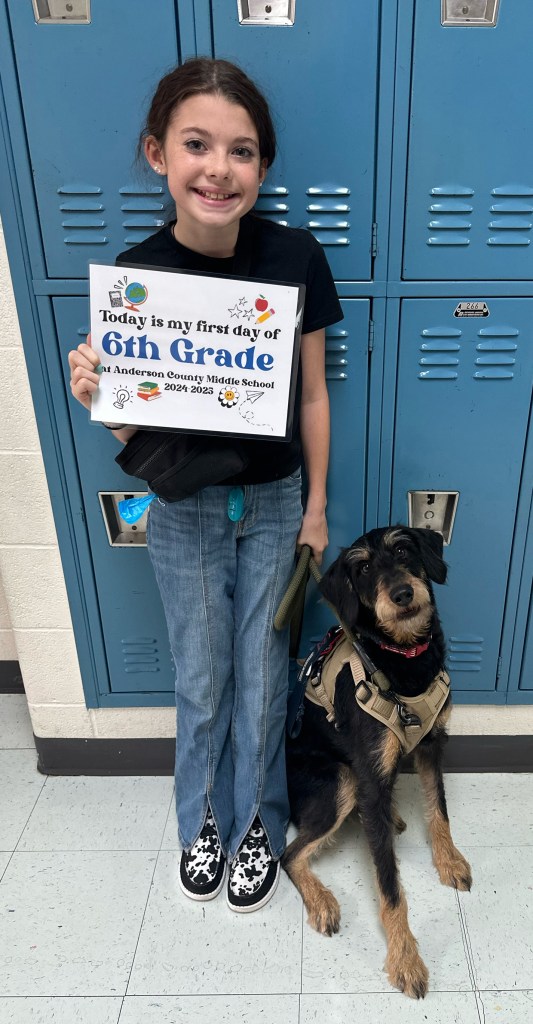
Apollo is a one-year-old “Dobiedoodle” trained by Liz Norris with Pawsibilities Unleashed in Frankfort. His handler, Izzabella, has a rare genetic disorder called Stickler Syndrome. Apollo helps with protecting Izzabella by watching for cars that she may not hear (she is partially deaf), alerting for drops in her blood pressure or heart rate, mobility assistance, and blocking and covering when strangers approach.
Izzabella’s mom Morgan said, “Without the assistance of Pawsibilities Unleashed, we would not have the sense of security that Apollo has given us. He has helped with the anxiety of not knowing when things are going to happen and given us the peace of mind that Izzabella is never fighting this alone.”
Morgan said Apollo saved Izzabella’s life in February by alerting them to her dangerously low blood pressure and heart rate while she was asleep. She spent two weeks at UK Children’s Hospital recovering.
“He truly is our blessing,” Morgan said. “We cannot thank Liz enough for matching us with Apollo.”
Izzabella’s family resides in Lawrenceburg, Ky.
 Compass Communications