With Dr. Jennifer Compton of Somerset Vision Center
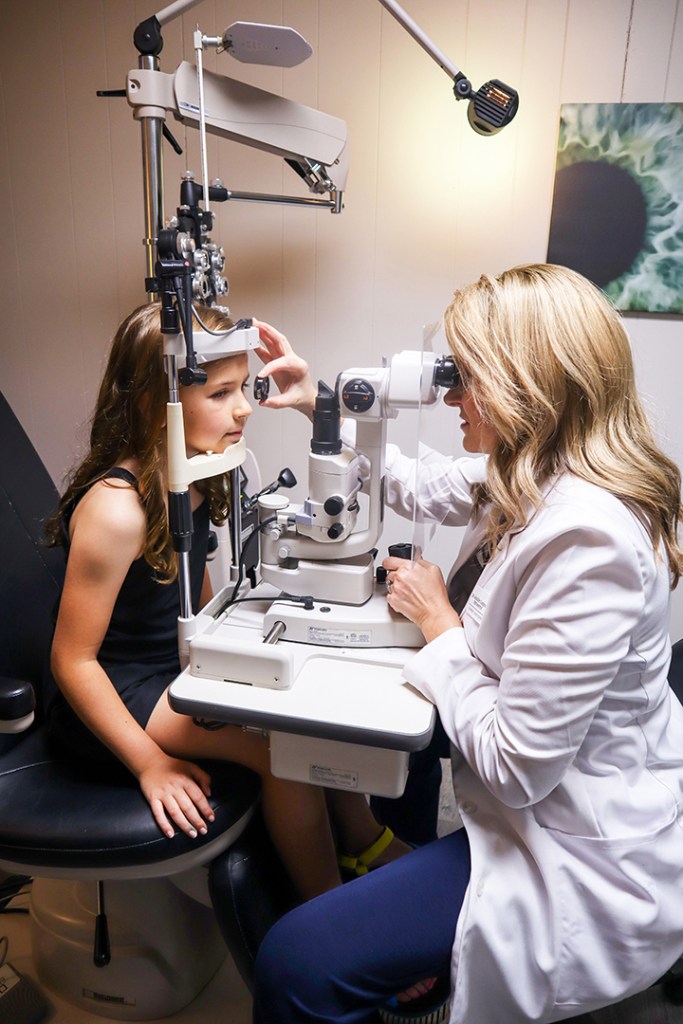
We asked Dr. Jennifer Compton of Somerset Vision Center to answer some questions about children’s vision health and to provide some insight into how to best care for our children’s eyesight.
While she enjoys caring for patients of all ages, Dr. Compton has a strong interest in pediatrics. Her belief in the importance of pediatric eye care led her to create a Mobile Eye Clinic that goes to area public schools, providing complete eye exams for students.
Dr. Compton’s mission is to reduce the obstacles that stand between children and the regular, preventative eye care they need. The Mobile Eye Clinic can help alleviate those barriers, including lack of transportation. It can also help parents not have to take time off from work to go to their children’s eye appointments.
If Mobile Eye Clinic services are offered at your child’s school, paperwork will be sent home with your child in August.

When is a child’s first eye exam recommended?
The American Optometric Association recommends that all children have their first complete eye examination by an eye doctor (optometrist or ophthalmologist) between 6 months and one year of age. Subsequent examination is recommended at least once between ages three to five and again at age six and yearly thereafter. To simplify this, I generally recommend a child’s first examination between six months and one year of age and annually thereafter. The early childhood years are a time of rapid developmental changes and learning. I really like to keep a close watch on these patients because their measurements (visual acuities, prescriptions, eye teaming and visual processing abilities) can change significantly in the course of a year. If we find that there are deficits or they are struggling academically, the sooner we intervene, the better the outcome. The guidelines from the AOA are for asymptomatic or low-risk children. Symptomatic and high-risk children may need more frequent evaluation.
There are some truly interesting statistics, that through the course of my career, I always gravitate back to:
- Eighty percent of a child’s learning occurs through vision.
- It is estimated that 10 million children need eye care in the United States.
- Half of these children face barriers that prevent them from receiving vision services.
- One in four children in the U.S. has a vision issue significant enough to affect their ability to learn.
Kentucky is a wonderful state with regard to their initiative to make sure students have an eye exam before entering preschool or kindergarten. This is a requirement for all children in public school within the state. Fortunately, unless a child is home schooled or in private school (these institutions do not fall under the same rules), all students in Kentucky must be evaluated at least once within their early childhood years. This enables us to identify any ocular or visual issues that will prevent normal vision development. I’m thankful to work in a state that has this legislature. It truly makes a difference.
Are there any signs that would indicate a child should have an eye exam sooner?
There are some telltale signs that a child needs an eye exam, but to be honest, most children are asymptomatic. When I have a pediatric patient with an issue that needs addressed, the first thing I tell the parent is that they did the right thing by bringing the child in for preventative care and even myself, as an optometrist, would not be able to detect many issues in my own daughter if I didn’t do a complete, dilated eye exam on her. There tends to be a lot of parental guilt in these situations, but if you’re bringing your child in for routine preventative care, you’re on the right track.
Children, in general, are not big complainers. They also aren’t able to discern what they should and should not be able to see. It is rare to have a child, even if they do notice a difference or discrepancy between their eyes, be able to communicate this to a parent or teacher. However, overt signs that a child needs to be seen are a crossed or a turned eye (strabismus), the closing of one eye on a regular basis, a droopy eyelid or abnormal light reflex in the pupils (for example, one pupil looks white while the other appears black). Also, if you walk into a room and your infant or toddler consistently does not seem to notice you or engage with you unless you make noise, this would be an extreme sign that the child may have a significant visual deficit.
How can someone best prepare their child for an eye exam?
First, do your homework and ask around. Some offices are more child-friendly than others (shorter wait times, play areas for children, staff and physicians that are comfortable with and enjoy caring for kids). These things matter. Also, I’m a big believer in being honest with my daughter when we’re going to the doctor about what will happen so that she’s not caught off guard and she doesn’t think that I’ve omitted information or lied to her about what the visit will entail. We let the parents know that at the first eye exam, they need to arrive a bit early and we will be dilating their child so that we can fully evaluate the health of the internal structures, as well as external structures, of the eye. Dilation for young children also helps us determine if there is any latent or “hidden” prescription that we might not have been able to detect undilated. The dilation drops for these first eye exams usually take about 30 minutes to take effect, so we let the parent know that after we dilate, the child can play in the play area and they can relax. We let them know that their child will be light sensitive and his or her near vision will be blurry and the duration of these side effects. We reassure them that the child will be given sunglasses at the end of the visit to make him or her more comfortable.
As far as what I tell the patients and parents when I first meet them in the exam lane, I let them know that we’re going to check a few things to make sure their eye muscles are strong, that their eyes are working together and that they’re healthy. We’ll use some special lights to do this. I let the child see the lights and hold them before we use them. This usually decreases any anxiety they have. We’ll also see if any glasses prescription is needed or anticipated in the near future. Parents are often fairly anxious about how their child is going to react to the eyedrops and also what will happen if they cannot read the eye chart. I tell parents not to worry. Even if their child is having a bad day or is minimally or even non-verbal, there are objective tests that we can do. An accurate, full eye examination can be done without the patient saying a word. Now, we love it when they do give us subjective responses and interact, but every child is on their own timeline when this happens developmentally, academically and socially.
In the event that we have a child who, typically due to significant medical issues early in life, is terrified of doctors and medical offices, I may just have the child come in first to get to know us and get comfortable. I like to develop some rapport with the patient and family. I might defer dilation at that visit and have them return in a couple weeks to take care of that portion of the exam. This doesn’t happen often, but we do allow for some flexibility if the situation calls for it. Occasionally if a child is terrified of eyedrops and instilling them in office would create significant anxiety, we’ll allow the parent to give the child their eyedrops the night before their appointment in the comfort of their own home. We try to do what works best for the individual child and family.
What are some common issues you see and how easily can they be corrected?
The most common thing I’m looking for in pediatric cases, especially in their early childhood years, is anything that would prevent them from having the ability to develop normal vision. The most common issues that can stunt vision development or cause a condition called amblyopia are:
- Unequal vision or unequal glasses prescriptions in each eye, usually farsighted in nature;
- An eye turn (strabismus);
- Ocular disease (which thankfully, is not as common as the other causes above).
The way I explain this to parents is that in the early childhood years, there are so many neural connections being made between the eyes and brain. For lack of a better way to say it, the brain can be a bit “fickle” during these years and if both eyes are not seeing equally (due to any of the issues above), the brain will essentially shut down vision development to the eye that is not normal (the eye that doesn’t see as well, has ocular disease or is not aligned properly). If these issues are caught early and addressed, we can encourage the brain to pay attention to the abnormal eye (the one that doesn’t see as well naturally or the eye that has the tendency to turn). This is typically accomplished with glasses prescription, patching therapy and in some cases, eye muscle surgery to realign the eye.
If my child needs glasses, is it likely he or she can “outgrow” the need for them in the future?
It truly depends on the type and magnitude of the prescription. Moderate to low farsighted prescriptions are often outgrown as the child gets older. Severe farsighted prescriptions may not be outgrown. Nearsighted prescriptions typically worsen as the child ages. I tell these parents to prepare for their child to have a lifetime of prescription wear, whether it be glasses or contact lenses. Astigmatism is a bit less predictable. In mild prescriptions, they may outgrow or be asymptomatic. In moderate to severe astigmatic prescriptions, they will likely need glasses or contacts for their lifetime. Patients may also be LASIK surgery candidates in adulthood if they are interested as well.
What kinds of glasses do you recommend for a child? At what age are children responsible enough for contact lenses?
For children, the durability and safety of the prescription is of utmost importance. For infants and toddlers, we typically recommend one-piece rubberized frames. They are flexible, there are no sharp edges or hinges to worry about and they can take a beating. Children are not known to be the easiest on glasses. As the child matures and becomes more responsible, many times they like to pick out “big boy or big girl” glasses that look more like smaller-sized versions of what their parents might wear or they see their peers wearing at school. Some children prefer plastic frames. Others, particularly those with small or flat nasal bridges, may benefit from metal frames with nose pads to help keep the frames from sliding down the nose. These are all on a case-by-case basis. We do recommend all lenses for minors be made of a material called polycarbonate. The reason why we recommend this material over some other plastics is that polycarbonate is less likely to shatter in the event of blunt force, such as in a car accident or getting hit with a ball at a sporting event, for example. We want do not want the frame or lens to cause injury to the child. Now, for children playing sports, regular glasses are not recommended. For sports, contact lenses or sports goggles (which are specific safety-rated frames and lenses) are always recommended.
Regarding contact lenses, the middle school years are typically when we notice most pediatric patients inquiring about starting to wear these. However, I’ve encountered some 6- and 7-year-olds that are more mature and responsible than some of my adult patients and we fit them in contacts and they did fantastic. What I tell parents is that when the child is truly interested and motivated to wear contact lenses and the parent thinks they are ready for the responsibility, we’ll try it. If I sense that the parent is pushing for contact lens wear and the child is not interested or is terrified, I’ll discourage it. On the flip side if the child really wants to, but the parent is hesitant or likely won’t be a good support system for the child in the learning process, I’ll recommend that we wait until both parties are ready. Both the patient and parent have to be on board, otherwise, it will not be a good experience. As a contact lens wearer myself, I also know that a bad first experience with contact lenses can really make or break it for the patient. I have some adult patients that are mentally scarred by how poorly their first contact lens experience went, that they’ve resorted to full time glasses wear and are afraid to retry as an adult when it would truly benefit them. We try to ensure that we’ve checked all our boxes and everyone involved is motivated and invested. It makes a world of difference.
Dr. Jennifer Compton is a licensed Doctor of Optometry. She is a 1998 graduate of Somerset High School. She received her Bachelor of Arts Degree in Child and Family Studies from Berea College in 2002 and went on to earn her Doctorate from University of Alabama at Birmingham School of Optometry. She has been practicing since 2008. Dr. Compton is accepting new patients at Somerset Vision Center located at 709 E. Mt. Vernon Street, Suite 1 in Somerset. Call 606-679-5177 or visit www.somersetvisioncenter.com.
 Compass Communications